Core Holders


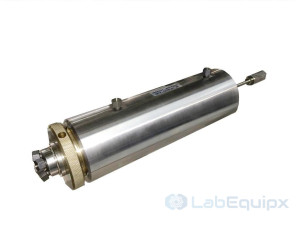


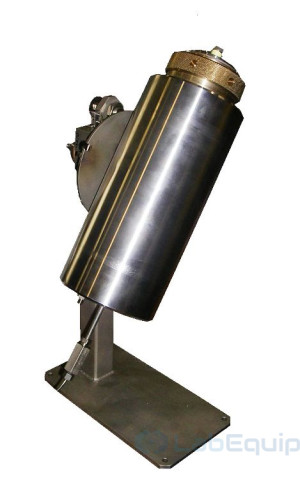

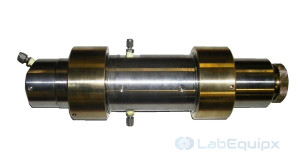
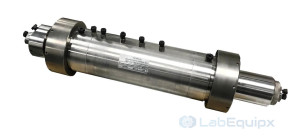

A core holder is the pressure vessel that confines a cylindrical rock sample while test fluid passes through it. A sleeve separates confining fluid from pore fluid; end platens seal the faces and carry the flow ports. Coretest manufactures Hassler, hydrostatic, triaxial, leakoff and imaging-compatible core holders for core flooding and SCAL measurements. Bore and length are customer specified on most models; full-diameter bores are project-dependent.
What the range covers
- Hassler, Hydrostatic and Leakoff Core Holders, each also as a Pressure-Tapped version
- Triaxial Core Holder and Quick-Release Core Holder
- X-Ray Transparent Core Holder and NMR / MRI Core Holder
- Resistivity Core Holder and Capillary Pressure / Resistivity Core Holder (4-pole and 2-pole)
- Core Holder Heating Mantle and Core Holder Stand
Engineering features
| Type | Loading | Typical use | Notes |
|---|---|---|---|
| Hassler | Radial confining pressure, axial platen loading | Permeability, core flooding | 5,000 psi, 150 °C, Viton sleeve, stainless steel, Hastelloy or titanium |
| Hydrostatic (biaxial) | One confining fluid acts radially and axially | Relative permeability, capillary pressure under overburden | 5,000, 10,000 or 15,000 psi, up to 150 °C |
| Triaxial | Independent axial and radial pressure | Stress-dependent flow and deformation | 7,500 psi, 200 °C, 1 inch core up to 4 inches, 316 stainless steel |
| Leakoff | Confining pressure plus tangential circulation across one end face | Drilling fluid invasion, formation damage | 10,000 psi confining, 5,000 psi pore and mud, Hastelloy |
| X-ray transparent | Hydrostatic | In-situ saturation in CT scanners | Titanium alloy pressure boundary, 10,000 or 15,000 psi, 150 °C |
| NMR / MRI | Hydrostatic | Saturation and pore size in the magnet | Non-magnetic composite body, PEEK liner, Teflon sleeve, 5,000 psi (1 and 1.5 inch) or 3,000 psi (1 inch) |
| Resistivity | Hydrostatic with electrical feedthroughs | Resistivity index | 2-point and 4-point, 10,000 psi, 150 °C |
| Quick-release | Radial confining, quarter-turn bayonet closure | High throughput at low pressure | 400, 1,000 or 5,000 psi, up to 80 °C, nitrile sleeve |
Pressure-tapped versions place taps along the sleeve axis at customer-specified positions to read intermediate pressure drop. End connections are NPT, Autoclave or HIP. The heating mantle holds the body at up to 150 °C. Stainless steel is standard; Hastelloy and titanium serve brine, CO2 or sour fluids.
Selecting a configuration
Pressure rating follows the highest confining pressure of the planned tests; sleeve, wetted materials and taps follow the fluids and the measurements:
- Sample diameter and length, including full-diameter core
- Maximum confining and pore pressure, and whether axial stress is controlled separately
- Operating temperature
- Test fluids and corrosivity: brine, live oil, CO2, H2S, acids
- Measurement channels: pressure taps, electrodes, X-ray or NMR access
- Applicable practices such as API RP 40
Typical applications
- Core flooding and EOR displacement, see the guide Core Flooding Experiments: Setup, Equipment, and Common Mistakes
- Gas permeability under confining stress, see Gas Permeability Measurement: Methods, Formulas, and Ranges
- Relative permeability, capillary pressure and resistivity index at reservoir conditions
- Drilling fluid leakoff and formation damage studies
Reference values above describe the product family. Guaranteed performance, included hardware, exclusions, interfaces and acceptance criteria are stated only in the project-specific technical proposal and approved datasheet.
