Altitude Test Chamber
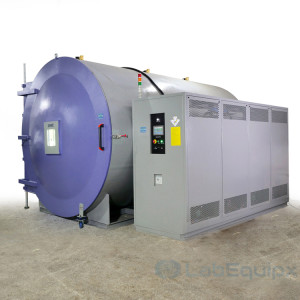
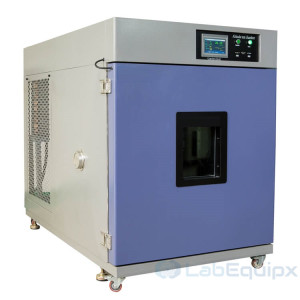

An altitude test chamber lowers the absolute pressure in a sealed working space to reproduce the thin air met by equipment in flight, at high elevation sites or in unpressurized cargo holds. The test shows whether sealed housings deform or leak, whether parts overheat as convective cooling falls off, and whether cells vent or arcing starts. Combined units add temperature and optional humidity, as MIL-STD-810 Method 500 and RTCA DO-160 Section 4 require.
What the range covers
- Altitude Test Chamber, LEATC-150 to LEATC-1000: low pressure with temperature, optional humidity, 150 to 1000 L
- High Altitude Low Pressure Simulation Test Chamber/Altitude Test Chamber, LEATCH-150 to LEATCH-1000: extended vacuum options, 150 to 1000 L
Engineering features
The working space is a SUS 304 stainless steel pressure boundary inside a powder coated cabinet, with interiors from 500 x 600 x 500 mm to 1000 x 1000 x 1000 mm. Pressure is controlled from atmospheric down to about 133 Pa residual (nominal -98 kPa gauge), with high vacuum options to 0.05 Torr or 0.001 Pa on the LEATCH series; this covers ground level to 100,000 ft. Pump-down takes 20 to 50 min.
Control tolerance is ±0.1 kPa below 2 kPa, ±5 % from 2 to 40 kPa and ±2 kPa above. Low temperature limits run from -20 °C down to -160 °C and high limits from +150 °C to +500 °C, selected per project; ±0.5 °C fluctuation is a reference value at room pressure. Thin air carries less heat, so combined chambers need more refrigeration and heater capacity than a thermal chamber of equal volume.
A program controller sequences vacuum pump, vent valve, refrigeration and heaters through multi-segment profiles. Data logging, lead-throughs, window and shelving are project-dependent. Over-temperature and pump fault protection stop the program.
Selecting a configuration
Altitude alone needs a pump sized to volume and rate of climb; combined temperature and altitude sets the refrigeration load. To quote, we need the following.
- Test standard: MIL-STD-810 Method 500, RTCA DO-160 Section 4, IEC 60068-2-13 or 2-39/2-40 combined
- Maximum altitude or minimum pressure, and rate of change in ft/min
- Temperature range, and whether humidity is needed at the same time
- Specimen dimensions, mass, heat dissipation and lead-throughs needed
- Dwell time at altitude and total test duration
- Site utilities: three phase supply, cooling water, pump exhaust
Typical applications
- Avionics and airborne equipment per RTCA DO-160 Section 4
- Battery packs and cells in low pressure transport and operation
- Sealed sensors, displays and enclosures for leak checks
- Combined temperature and altitude qualification of defense hardware
Reference values above describe the product family. Guaranteed performance, included hardware, exclusions, interfaces and acceptance criteria are stated only in the project-specific technical proposal and approved datasheet.
