AGREE Chamber
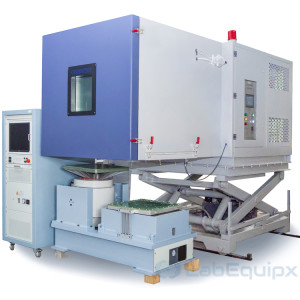

An AGREE chamber is a temperature and humidity chamber whose floor opens onto a vibration shaker, so hardware is cycled thermally while shaken. The name comes from the Advisory Group on Reliability of Electronic Equipment, whose work became the combined-environment tests of MIL-STD-781 and later MIL-STD-810. Faults that appear only under stacked stress, solder joints cracking at cold, fasteners loosening at hot, connectors going intermittent, are found in one test that neither a thermal chamber nor a shaker alone reveals.
What the range covers
- AGREE Chamber LETHV: 63 to 6000 L, -70 to +180 °C, 10 to 99 %RH, sized to the customer shaker
Engineering features
The cabinet has a SUS 304 stainless steel interior, a powder coated exterior and PU and fiberglass wool insulation. The full-opening door carries a multi-panel heated window and interior light. The floor is changeable to accept different floor plugs, so one cabinet can be matched to an electrodynamic or hydraulic shaker with a plug cut to its table; inputs up to 5000 kgf and 100 g are accommodated. A 50 mm cable port with flexible plug sits in the left wall.
Air passes through a rear-mounted plenum with cooling coil and nichrome wire heaters, driven by two 3/4 hp blowers on one-piece stainless shafts. Cooling is a non-CFC cascade refrigeration system with semi-hermetic compressors. Standard cooling rate is 2 to 3 °C/min; 5, 10 and 20 °C/min are options.
The program controller stores 120 profiles of up to 1200 steps each and communicates over USB, RS-232 and RS-485 for logging and coordination with the vibration controller. Over-temperature and refrigerant pressure protection are typical; shaker safety circuit integration is defined per project.
Selecting a configuration
An AGREE chamber is built around the shaker it will sit on, so the shaker data comes first. To quote, we need the following.
- Shaker make and model, armature or slip table size, and whether the chamber stands over it or rolls in on a frame
- Test profile: MIL-STD-810 Method 520 combined environments (typically referenced), RTCA DO-160, or a customer ESS profile
- Specimen size, mass, fixture height and heat dissipation
- Temperature range, required rate of change in °C/min, and whether humidity is needed
- Vibration axis (vertical, or horizontal with slip table) and maximum force
- Site utilities: three phase supply, condenser cooling water, shaker compressed air
Typical applications
- Combined-environment reliability testing of avionics and defense electronics
- Environmental stress screening of production assemblies
- Automotive electronic modules under thermal cycling with road vibration
- Battery packs and power electronics under stacked loads
Reference values above describe the product family. Guaranteed performance, included hardware, exclusions, interfaces and acceptance criteria are stated only in the project-specific technical proposal and approved datasheet.
