Send a request
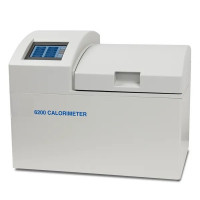
Automatic Isoperibol Calorimeter
The LEAIC-6400 Automatic Isoperibol Calorimeter automates calorimetric tests in a compact instrument. Its integrated cooling circuit operates in a closed loop. A thermoelectric cooler is attached directly to a one liter water tank, which supplies the calorimeter with cooling water.
Rinse water comes from an external tank pressurized with nitrogen. The fixed bomb and bucket arrangement permits automatic filling of the bucket and jacket, together with automatic filling and rinsing of the combustion vessel. Operator involvement is one minute per test. At that level of attendance, a technician can operate up to four calorimeters at the same time.
This description defines the product family. Guaranteed performance, included hardware, exclusions, interfaces and acceptance criteria are stated only in the project-specific technical proposal and approved datasheet.
Complete system accessory package
The expanded package combines the components required to order a complete calorimeter system. The instrument and its supporting accessories are listed together below.
Contents of the expanded system Component group Supplied item Calorimetry instrument Calorimeter Rinsing equipment Tank for rinse water Output device Printer with USB connection Additional vessel hardware Extra vessel head assembly Vessel maintenance supplies Maintenance kit for the vessel Service supplies 1 Year service kit Operating specifications
- Measurement method: isoperibol calorimetry.
- Automatic filling of the bucket and jacket, together with automatic vessel filling and rinsing.
- Cooling cycle operates automatically.
- Test throughput: 6-7 tests per hour.
- The bomb cylinder stays fixed, with a removable head for rapid sample loading.
- Operator involvement per test: 1 minute.
- Instrument precision class: 0.1%.
- Temperature measurement resolution: 0.0001 ºC.
- Sample energy range: 5000 to 8000 calorie.
- Linearity over the operating range: 0.05%.
- SD memory storage and TCP/IP network communication.
- A USB Port connects a balance and printer.
- Software updates are available via the Internet.
- Overall dimensions (in): 16.5 wide X 15.5 deep X 20.0 high.
- Overall dimensions (cm): 42 wide X 40 deep X 51 high.
Instrument design
Stationary bomb and bucket
The automatic isoperibol calorimeter keeps both the bomb and the bucket installed during routine operation. This fixed arrangement allows automation throughout the calorimetric measurement, extending beyond data acquisition and reporting. Compared with a calorimeter whose bomb must be removed, the automated sequence saves approximately five minutes of operator work per test.
Oxygen filling and gas discharge
Because the bomb and bucket remain in place, oxygen can be supplied directly into the bomb head at the start of each test. A check valve in the head seals dynamically as bomb pressure rises. At the end of the measurement, the calorimeter automatically vents the gases while it returns to the starting temperature for the next test.
Bucket circulation and water handling
The bucket guides water smoothly around the outside surface of the vessel and fills repeatedly to a defined volume. Closing the bomb head also seals the bucket. The arrangement keeps the required test water quantity low and supports fast, automatic and repeatable filling. After the test, the bucket automatically drains the water heated by combustion. Cooling water replaces it, bringing the bomb and bucket back to the initial temperature quickly so another measurement can begin.
Fixed bomb closure and rinsing
The fixed bomb uses a short-turn closure. A one sixteenth turn seals the head and locks it in the cylinder. The main O-ring seal is arranged to reduce frictional wear and extend seal life. Once the test is complete, the instrument washes the internal bomb surface to remove combustion products. Automating this step removes a time-consuming manual task associated with removable bomb instruments.
Automatic rinsing also starts as soon as the final temperature can be determined, generally within 4-5 minutes after firing. Prompt washing keeps contact time between combustion acids and the internal bomb surfaces as short as possible. This reduced acid exposure contributes to longer bomb service life compared with removable bomb arrangements.
Oxygen combustion vessel
The standard oxygen bomb has a construction intended to withstand a greater number of tests. Its head includes an O-ring groove arranged to reduce friction at the seal and extend the usable life of the O-ring. The head can be removed for fast sample loading. A quick twist-lock closure secures it back into the vessel cylinder.
The standard bomb uses alloy 20, a niobium stabilized stainless steel selected to resist the mixture of nitric and sulfuric acids produced by combustion. An alternative halogen-resistant bomb uses G30 alloy. This alternative is specified for resistance to free chlorine and halogen acids released by samples with substantial chlorine content. The alternative bomb is recommended when these samples will be tested, although no alloy completely withstands every corrosive atmosphere produced by burning halogen-containing compounds.
Both bomb versions have a volume of 250 mL and a rated working pressure of 2000 psi. Hydrostatic testing is performed at 3000 psi. The sample range is ~1g, releasing up to 8000 calories per test.
Additional bomb head
A spare vessel head supports maximum calorimeter throughput. While a test is running, the next sample can be fully prepared on the additional head. When the current measurement ends, the prepared sample and head can be inserted immediately into the bomb.
Control chart display
A control chart plots measurement results to help determine whether the measurement process remains under control. Many standard methods require periodic measurement of a reference sample, with the results plotted against defined acceptance limits. Results within the limits indicate that the process is under control. Normal random variation is expected to produce scatter within the established limits. Systematic trends or recurring patterns in the plotted data may indicate a developing problem even before a limit is exceeded. The calorimeter can immediately plot and display standardization results using warning and control limits defined by the operator.
Required laboratory services
The instrument requires 99.5% oxygen, nitrogen or house air supplied at 80 psi, and deionized water.




| Brand | Coretest |
