Send a request
Detonation Calorimeter
The Detonation Calorimeter supports research that combines calorimetric measurements with dynamic pressure data. These measurements provide fundamental information about detonation and can support prediction of explosive performance. Ordinary oxygen bomb calorimetry measures combustion or reaction heat in oxygen or an inert atmosphere. Even a high-strength oxygen combustion vessel may not readily establish the conditions needed to detonate a small highly reactive sample, and the outcome can be unpredictable.
Combustion heat and detonation heat differ. For pentaerythritol tetranitrate (PETN), with formula C5H8N4O12, the conventional combustion heat in oxygen is 1957 cal/g. Detonation in vacuum gives 1490 cal/g, a difference of 24%.
Confinement also strongly affects the energy released by explosive materials. With an unconfined or lightly confined charge, much of the released energy stays in the reaction products. Under heavy confinement, most of the detonation energy becomes kinetic and internal energy of the surrounding case. For example, the conventional combustion heat of 2,4,6-trinitrotoluene (TNT) in oxygen is 3590 cal/g. Its detonation heat is 1093 cal/g at a charge density of 1.53 g/cc, and 870 cal/g at 0.998 g/cc. An unconfined reaction, by comparison, releases approximately 600 cal/g.
The calorimeter accepts a high explosive charge up to 25 g, with a nominal total energy release of ~160 kJ per charge. Initiation uses a small commercial EBW-style detonator containing 80 mg of PETN and 450 mg of RDX with a binder. The firing equipment is a one-microfarad, 4000 V capacitance-discharge set.
A complete calorimetric measurement takes a few hours and provides precision of several tenths of a percent. An optional high-speed pressure transducer can be fitted to the bomb to record further information about the dynamics of the detonation process.
This description defines the product family. Guaranteed performance, included hardware, exclusions, interfaces and acceptance criteria are stated only in the project-specific technical proposal and approved datasheet.
Precision thermometer for calorimetry
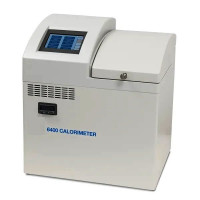
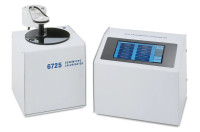
The calorimetric thermometer records every temperature reading and controls the full sequence of the calorimetric test. A color touch screen presents its graphical operating interface. It measures both the stirred water around the bomb and the calorimeter jacket. During each test, the thermometer continuously applies heat leak corrections. The final temperature rise for that run therefore includes the complete heat leak correction.
An Ethernet LAN connection allows the thermometer to join the laboratory network. Its built-in services include web, FTP and VNC servers. The VNC remote interface permits operation of the calorimeter from a network-connected PC using MS Windows or Linux. This gives the operator access to the instrument's interface from the connected computer.
Recording dynamic pressure
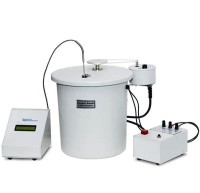
The dynamic pressure recording equipment works with the detonation calorimeter to measure the pressure changes inside the bomb during detonation. These measurements support the study of pressure transients associated with rapid decomposition of materials used as explosives. The recording equipment comprises the following subsystems:
- A dynamic pressure transducer with a fast response is paired with signal conditioning electronics. The transducer measures pressures up to 10000 psi, and its usable frequency range extends to an upper limit of 100 kHz. It detects pressure changes as small as 0.5 psi. Measurement accuracy is 1% of full scale. The measurement system has a time constant of approximately 10 minutes, allowing short-duration static or quasi-static pressure measurements as well as dynamic measurements.
- A PC-based data acquisition unit records the pressure transducer output through a USB interface. Its acquisition rate is 200 kS/s. Manual activation of the bomb ignition unit or firing set can trigger the acquisition or synchronize it with firing. Pressure measurements obtained after the trigger are stored in a disk file on the PC.
- The supplied user interface software runs under Windows. Once the combustion event starts, the program streams the acquired data to disk. The recorded data can then be exported to a spreadsheet for additional analysis and preparation of plots.
Main equipment assemblies
Detonation vessel
The bomb has a spherical stainless steel body with a wall thickness of 3.2 cm. Its inside diameter is 21.6 cm, giving an internal volume of 5.3 liters. The opening measures 9 cm across. A lid closes this opening and has a central thickness of 3.8 cm. An O-ring seals the lid, which is held by 12 high-strength bolts of 1.3 cm diameter passing through its flange. At the center of the lid is a fitting for lifting the bomb. Around that fitting are an inlet / outlet valve and two insulated electrodes of the high-voltage type. A port for a fast-response pressure transducer can be added to the lid as an option. The combined mass of the vessel body and lid is 55 kg.
Calorimeter support stand
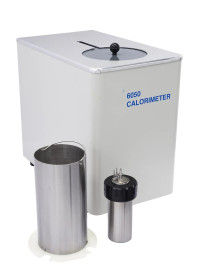
The detonation calorimeter uses a compensated static jacket arrangement. The stand contains the calorimeter jacket and carries a hoist for lifting the bomb. It also provides a bomb support and a separate stand for the bomb head, positioned for access during handling. When the calorimeter lid is removed, it can be stored on the lower shelf beneath the bomb workstation.



| Brand | Coretest |
