Send a request
CT-STIM-FDESF
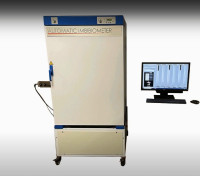
Formation Damage Evaluation System (Filtration Unit)
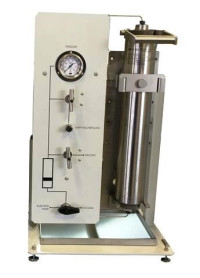
The Formation Damage Evaluation System (Filtration Unit) is a core flood apparatus that determines the filtration and capacitive properties of fluids on core. Formation damage, well treatment and EOR laboratories use it for acidization studies, drilling mud invasion, relative permeability, CO2 sequestration and multi-layer flow distribution. It is built in the USA by Keen Dynamics LLC (model FDES-650) and supplied by Coretest as CT-STIM-FDESF.
How it works
A 1.5 inch core, 1 to 6 inches long, is loaded in a core holder on a pivoting mount that keeps the confining lines connected. Confining pressure of 0 to 10,000 psi and pore pressure up to 10,000 psi are applied, and the holder sits in an oven at test temperature. Test fluids are held in four 500 ml piston accumulators driven by VPA dual-piston syringe pumps for pulse-free flow; an automatic fill system refills, heats and pressurizes accumulators without disturbing the oven. Pressure, temperature and filtration flow are controlled; filtered volume and capacitive response are measured.
Air-operated valves are integrated in the control software, which shows the flow path and instrument locations on screen. Data is logged to a PC at a user-set rate; the same touch screen software sets flow configuration, back pressure mode, active accumulator, oven temperature and pump mode. Wetted parts are Hastelloy C-276.
What is included
- Core holder for 1.5 inch cores, 1 to 6 inches long, on a pivoting mount
- Oven for temperature control
- VPA syringe pumps for pressure control
- Four 500 ml accumulators with automatic fill system
- Automatic valves integrated in the software
- PC-based data acquisition and control software with touch screen
Specify for your project
- Core holder: 1, 1.5 or 2 inch diameter, length to 12 inches, single or dual, radial, hydrostatic or triaxial loading
- Test temperature: 150 °C oven standard, 200 °C with modified seals
- Confining pressure control up to 20,000 psi, passive or active, with or without independent axial pressure
- Back pressure and sampling: VPA in pressure mode, dome-loaded regulator, acoustic separator, fraction collector or Coriolis meter
- Differential pressure module, including the dual quartz transducer option
- Options: pressure ports and thermocouples along the core, gas injection, fluid recirculation, micro CT compatibility, accumulators 20 to 2000 ml
This description defines the product family. Guaranteed performance, included hardware, exclusions, interfaces and acceptance criteria are stated only in the project-specific technical proposal and approved datasheet.
Origin USA Confining Pressure:
0 to 10,000 psi
Pore Pressure
Up to 10,000 psi
Core Diameter:
1.5"
Core Length:
1"-6"
Temperature:
Oven
Pressure Control:
VPA Syringe Pumps
Accumulators:
500 ml, 4 pcs
Wetted Parts:
Hastelloy C-276
Constructed according to your specific requirements
Our equipment can be easily tailored to the precise requirements of a specific customer application, owing to the broad range of tests that may be performed using a core flood system. The following is merely a small sampling of the numerous applications for which a our core flood system can be utilized:
- Research into enhanced oil recovery (EOR)
- Studies on acidization
- Assessment of flow distribution in reservoirs with multiple layers
- CO2 sequestration
- Analysis of drilling mud invasion
- Measurements of relative permeability
- Simulation studies
Simple to operate and upkeep
Our company strives to ensure that operating the core flood system is as straightforward and hassle-free as possible. To achieve this, we have incorporated key features into the design, such as:
- A pivoting core holder mount that enables confining lines to stay connected
- An automatic accumulator fill system that allows for easy filling, refilling, heating, and pressurization without disrupting the test environment
- Automatic valves that are integrated into the software to facilitate tests and protect system transducers
- User-friendly schematics in the valve/gauge panels and software that provide a clear visual representation of the plumbing flow path and the locations of the instrumentation.
Industry leading new technology
We continuously strive to exceed the standard expectations of a core flood system by incorporating cutting-edge measurement technologies and features such as:
- Pressure ports and thermocouples embedded along the core sample
- Gas sampling and fluid separators
- Fluid recirculation
- Compatibility with micro CT scanning
- Syringe pump control of unique experimental variables
- Leveraging our expertise and knowledge, we are fully equipped to meet your specific requirements.
Please don't hesitate to reach out to us to discuss how we can provide a system tailored to meet your specific requirements. We would be happy to speak with you and answer any questions you may have.
Core holder
The core holder is responsible for enclosing the core sample and exposing it to simulated reservoir conditions. A variety of core holder options are available in our core flood systems, including:
- Single or dual core holders
- Pivoting mount frame for horizontal or vertical orientation
- Roller-supported mount frame for easy movement and maintenance
- Pivoting mount to transition from inside to outside oven for sample loading
- Radial confining pressure, hydrostatic, or triaxial loading capabilities
- Range of core diameters (1", 1 ½", 2")
- Core lengths of up to 12"
- Multi-tap pressure ports running along the length of the core
- Imbedded sensors located along the length of the core holder sleeve.
Upstream Flow System
Our versatile pump apparatus (VPA) is a family of dual piston syringe pumps specifically designed for core flood applications in the upstream flow system. These pumps use special algorithms that ensure pulse-less flow to drive fluid separator accumulators, making them an ideal solution for precise flow control. We offer a range of features that can be customized to meet specific test requirements, including pressure range and flow rate for the VPA(s), multiple VPAs for simultaneous multi-phase flow, flow path forward or reverse, or in parallel or series through multiple core holders, and options for wetted parts including stainless steel or Hastelloy C 276. Tubing sizes of 1/16", 1/8", or 1/4" are also available. Additionally, our VPA system includes a gas injection system for enhanced functionality.
Heating
Heating options for the core flood system include a variety of features designed to meet specific testing requirements. One option is a custom-designed stainless steel oven that encloses the core holder(s) and fluid separators, allowing core flooding tests to be routinely conducted up to 150°C. With specialized seal materials and component modifications, tests up to 200°C can be achieved. Additionally, other heating options include heating jackets and rod heaters, which can be used to heat components to reservoir temperatures.
Fluid accumulators
Fluid accumulators in a core flood system allow for the controlled flow of multiple fluids through a core sample. Our system features a bank of piston-type accumulators, which can be operated in sequence or simultaneously. Air-operated automatic valves allow for easy selection and filling of the active accumulator(s) without disturbing the temperature environment of the oven. To drive the fluid accumulators, we use one or more VPA pumps, providing pulseless flow to avoid disturbing the core sample. Our fluid separators are designed to handle highly corrosive fluids without putting the VPA at risk. These separators are made with wetted parts of materials such as Hastelloy C 276, titanium, stainless steel, Teflon, and PEEK, and can accommodate volumes ranging from 20 to 2000 ml and pressures up to 20,000 psi.
Confining Pressure Control
The system for controlling the confining pressure manages the pressure around the core sample, as well as the axial pressure applied to it if necessary. Various options are available, including:
- Pressure control up to 20,000 psi
- "Passive" pressure control using isolation valves
- "Active" pressure control using a back pressure regulator or VPA
- Independent axial pressure control
Differential Pressure Measurement Module
Precise differential pressure measurement is crucial for accurate calculations of permeability and other flow parameters. To achieve this, differential pressure must be measured across the length of the core sample and between ports on core holders that have multi-tap pressure ports. Choosing the right differential pressure transducer(s) depends on the differential pressure range and system pressure rating. Our team of engineers can assist in selecting the best transducer(s) for a specific application. We also offers a unique design that uses dual quartz pressure transducers with one part per billion resolution and an air-operated shorting valve to provide highly accurate and stable differential pressure measurement.
Back Pressure Control and Fluid Sampling System
The downstream pore pressure in the system is crucial to accurate flow rate and volume measurements during core flood tests. The back pressure control system provides precise control of this pressure and offers various options to meet specific test requirements, including:
- Using VPA in pressure mode to control back pressure and measure fluid volume
- Dome-loaded back pressure regulator
- Acoustic Separator
- VPA and Acoustic Separator
- Fraction Collector
- Coriolis mass flow meter.
Data Acquisition and Test Control System
Automatic data acquisition is performed by each transducer in the system. A PC-based system is used to collect and store data for specific tests at a user-defined rate. The same software program is also used for test control. An intuitive touch-screen interface allows the operator to set various parameters, such as flow configuration, back pressure control mode, active accumulator, oven temperature, and VPA control mode. Graphical representations of flow configuration and other test parameters are displayed to the operator. Additional screens allow for maintenance purposes, such as individual control of automated valves, and entry of transducer calibration values. This data acquisition and test control software is tailored to each specific test system.



| Model | CT-STIM-FDESF |
| Brand | Coretest |
| Model | FDES-650 |
| Manufacturer | Keen Dynamics LLC |
