Send a request
CT-CP-ACC
Automated Core Centrifuge
Coretest · core centrifuge
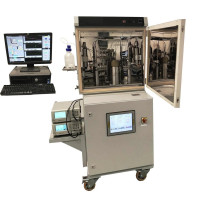
The Automated Core Centrifuge is the top model of the line. It reaches 13,000 rpm and more than 31,000 ×g, so it covers high capillary pressure on tight rock, and it reads the produced volume in every tube while the rotor turns. A stroboscope and a camera image each measuring tube once per revolution, and the software finds the liquid level automatically. Drainage and imbibition use interchangeable bucket sets on the same rotor yoke, which makes a full USBM cycle possible on one machine.
Three centrifuges, three levels
Coretest builds three core centrifuges for capillary pressure work. They differ in how saturation is read and in speed; pick the one that matches your test programme.
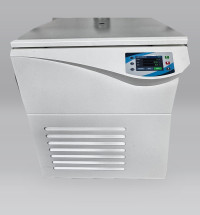
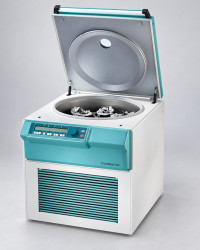
Model How saturation is measured Rotor Typical use UC-200 High-Speed Core Centrifuge Plugs weighed after each speed step fixed rotor, 1 in or 1.5 in plugs Swi end-points, drainage curves, plug preparation on a budget Refrigerated Centrifuge LERC4500 Camera reads each receiving tube during rotation 6 holders, 26 cm rotor radius, 5 to 90 °C Drainage and imbibition at moderate speed, relative permeability from production Automated Core Centrifuge Stroboscope and camera, automatic level detection 3 × 1.5 in buckets, 13,000 rpm High capillary pressure, full drainage–imbibition cycles, USBM Drainage and imbibition buckets
In the standard drainage bucket the displaced liquid collects at the outer end of the measuring tube. In the inverted imbibition bucket the tube is filled with water before the run; water is driven into the plug and the displaced oil or air rises to the inner end of the tube, where its volume is read.
Capillary pressure at the inlet face of the plug for each step: Pc = ½ · Δρ · ω² · (r₂² − r₁²), where Δρ is the density difference of the fluid pair (kg/m³), ω = 2π · rpm / 60 (rad/s), r₂ the radius of the plug outlet face and r₁ = r₂ − plug length (m). The outlet face is at Pc = 0.
Camera readout
The imaging module sits above the lid window. The stroboscope fires in phase with each bucket, so every image freezes one tube. The software converts the level to produced volume, logs it against time and speed and judges equilibrium per step. Capillary pressure curves are calculated with the Hassler–Brunner or Forbes approximation, and the production data can be exported for relative permeability interpretation.
Specification
The full specification is on the Specification tab. Download the datasheet (PDF).
Supplied with
- Centrifuge with vacuum system and 10 in touch-screen control
- Rotor yoke with drainage and inverted imbibition bucket sets, adapters and measuring tubes
- Imaging system: industrial computer, camera, stroboscope
- Acquisition and capillary pressure software with automatic level detection
- Operation manual and factory test report
Guaranteed performance, rotor geometry, included hardware and acceptance criteria are stated in the project-specific technical proposal and approved datasheet. Images are for reference; the delivered configuration may differ.
Specification
Plugs per run 3 × 1.5 in, up to 2 in long (maximum 1.555 × 2.010 in); 1 in rotor on request Bucket sets drainage (standard) and imbibition (inverted), interchangeable on one rotor yoke Plug face radii drainage 43.0 / 93.8 mm; imbibition 115.5 / 166.3 mm Speed up to 13,000 rpm, ±20 rpm RCF at outer plug face 17,720 ×g drainage; 31,420 ×g imbibition Readout stroboscope and camera image each measuring tube during rotation; automatic level detection Measuring tube 6 mL, 0.1 mL graduation as standard; other volumes per project Temperature 20 to 40 °C during tests; vacuum chamber Rotor life 13,000 rpm for 1,000 runs or 2,500 h, then 10,000 rpm up to 5 years Power 220 V ±10 %, 50 Hz, single phase, 30 A Size / weight 700 × 900 × 1300 mm / 450 kg Guaranteed values are stated in the project-specific technical proposal.


Comparable instruments
Side-by-side comparisons based on each manufacturer’s published specifications.
- Alternative to the Core Lab ACES-300
Coretest Automated Core Centrifuge vs the Core Lab ACES-300: speed, rotor radius, plug size, readout and temperature from published specifications. - Alternative to the Vinci UC20
Coretest Automated Core Centrifuge vs the Vinci UC20: speed, rotor radius, plug size, readout and temperature from published specifications. - Replacement for the Coretest URC-628
Replacing a URC-628 ultra rock centrifuge: the Coretest Automated Core Centrifuge with strobe camera readout, drainage and imbibition, method transfer.
Model names are trademarks of their respective owners. Coretest is not affiliated with these companies.

| Model | CT-CP-ACC |
| Brand | Coretest |
