Send a request
LERC4500
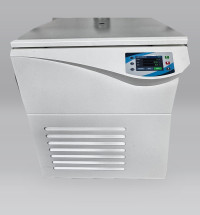
Capillary Pressure Refrigerated Centrifuge LERC4500
Coretest · core centrifuge
The LERC4500 is the middle model of the line: a refrigerated centrifuge with a 26 cm rotor radius and a camera that reads the receiving tube of every holder while the rotor turns. Long arms give high capillary pressure at moderate speed, so the speed stays stable and the interface is read cleanly through the whole run. It runs forced drainage and imbibition on up to six plugs at once and records production against time for relative permeability work.
Three centrifuges, three levels
Coretest builds three core centrifuges for capillary pressure work. They differ in how saturation is read and in speed; pick the one that matches your test programme.
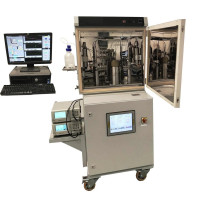
Model How saturation is measured Rotor Typical use UC-200 High-Speed Core Centrifuge Plugs weighed after each speed step fixed rotor, 1 in or 1.5 in plugs Swi end-points, drainage curves, plug preparation on a budget Refrigerated Centrifuge LERC4500 Camera reads each receiving tube during rotation 6 holders, 26 cm rotor radius, 5 to 90 °C Drainage and imbibition at moderate speed, relative permeability from production Automated Core Centrifuge Stroboscope and camera, automatic level detection 3 × 1.5 in buckets, 13,000 rpm High capillary pressure, full drainage–imbibition cycles, USBM How a test runs
A plug saturated with one phase is placed in the second phase inside a holder with a calibrated receiving tube. The rotor steps through a series of speeds and holds each until the phases stabilise. A digital camera images the receiving tubes during rotation, and the software converts the interface position into produced volume. The same holder design serves drainage and imbibition.
Capillary pressure at the inlet face of the plug for each step: Pc = ½ · Δρ · ω² · (r₂² − r₁²), where Δρ is the density difference of the fluid pair (kg/m³), ω = 2π · rpm / 60 (rad/s), r₂ the radius of the plug outlet face and r₁ = r₂ − plug length (m). The outlet face is at Pc = 0.
Temperature and chamber
Refrigeration and heating hold the samples between 5 and 90 °C for the whole run. The chamber is open, without a rotor windshield, so air circulates freely and two sensors control the temperature at the samples; this also shortens pre-cooling and makes the rotor easy to load and clean. Spontaneous imbibition and drainage are done outside the centrifuge in Amott cells; the centrifuge covers the forced part of the cycle.
Specification
The full specification is on the Specification tab.
Overburden option
For tests at reservoir stress, dedicated core holders apply hydrostatic confining pressure up to 5,000 psi and pore pressure up to 1,450 psi with a manual pump before the run. The pressure does not need to be released when switching from drainage to imbibition.
Supplied with
- Refrigerated centrifuge with heating
- Rotor with core holders and receiving tubes
- Camera, computer and acquisition software
- Seals, grease and tool kit; operation manual
Guaranteed performance, rotor geometry, included hardware and acceptance criteria are stated in the project-specific technical proposal and approved datasheet. Images are for reference; the delivered configuration may differ.
Specification
Core holders 6; 1 in, 30 mm or 1.5 in plugs Plug length up to 4 in in atmospheric holders; up to 2.5 in in overburden holders (option) Receiving tubes 10 mL and 32 mL, calibrated Speed 50 to 4,500 rpm, regulation ±1 rpm, speed ramp Rotor outer radius 26 cm; up to 5,818 ×g Temperature 5 °C (at standstill) to 90 °C, refrigeration and heating, dual at-sample sensors Readout digital camera, 5488 × 3672 px; interface resolution better than 0.01 mL on a 10 mL tube Tests forced drainage and imbibition, air–liquid and oil–brine; production versus time for relative permeability Overburden option hydrostatic holders to 5,000 psi confining and 1,450 psi pore pressure, applied before the run Protection imbalance, rotor identification, overspeed, over-temperature, lid interlock Power 400 V, 3 phase + N Size / weight 973 × 813 × 1015 mm (H × W × D) / 450 kg Guaranteed values are stated in the project-specific technical proposal.


Comparable instruments
Side-by-side comparisons based on each manufacturer’s published specifications.
- Alternative to the Vinci RC4500
Coretest LERC4500 refrigerated centrifuge vs the Vinci RC4500: speed, rotor radius, plug size, camera readout and overburden from published specifications.
Model names are trademarks of their respective owners. Coretest is not affiliated with these companies.


| Model | LERC4500 |
| Brand | Coretest |
