Send a request
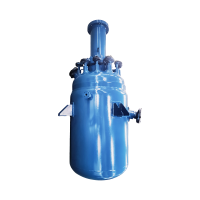
Bench Top Reactors (1 & 2 l) BTR-4520 Series
LEBTR-4520 bench top reactors have 1 & 2 l capacities and occupy the upper end of the size range suitable for bench mounting. Available seals include an FKM O-ring for temperatures to 225 °C, an FFKM O-ring for temperatures to 300 °C, and a flat PTFE gasket for a maximum operating temperature of 350 °C.
The optional HP (High Pressure) version uses a flat gasket and has a maximum allowable working pressure of 2900 psi (200 bar) at 350 °C. Both fixed head and moveable vessel arrangements are offered. A pneumatic lift can assist with the heavier 2 liter cylinder and heater. The fixed head 2 liter arrangement is tall, which can make operation awkward on a standard height bench. A floor stand is recommended for that configuration.
The relatively large diameter of these mid-size vessels leaves room for modifications. These include an internal cooling coil, a bottom drain valve except on the 2 liter bench top version, a ball valve at a solids charging port, catalyst addition equipment, condensers and electrical feed-throughs.
The standard magnetic stirring drive handles reaction mixtures with viscosities up to 25,000 centipoise. Higher stirring loads can be accommodated by fitting a larger magnetic drive, a higher-power motor and a drive train that supplies additional torque to the stirrer.
This description defines the product family. Guaranteed performance, included hardware, exclusions, interfaces and acceptance criteria are stated only in the project-specific technical proposal and approved datasheet.
Features
- Type: general purpose
- Stand: bench top
- Mounting style: moveable head or fixed head
- Vessel sizes, mL: 1000 to 2000 standard, 970 to 1900 HP
- Standard pressure rating (MAWP), psi (bar): 1900 (131)
- Standard maximum operating temperature, °C: 225 with FKM O-ring; 300 with FFKM O-ring; 350 with PTFE flat gasket
- High pressure (HP) rating (MAWP), psi (bar): 2900 (200)
- Maximum operating temperature at high pressure (HP), °C: 350
Version 1000 mL, fixed head 2000 mL, fixed head 1000 mL, moveable 2000 mL, moveable Approximate Volume, mL 1000 2000 1000 2000 Approximate Volume for HP Versions, mL 970 1900 970 1900 Maximum Pressure (MAWP) 1900 psi (131 bar) Maximum Pressure for HP (MAWP) 2900 psi (200 bar) Maximum Temperature with FKM O-ring 225 °C with FFKM O-ring 300 °C with PTFE Flat Gasket 350 °C Reactor Details Mounting Style Fixed Head Moveable Stand Type Bench Top Closure Split-Ring (6 Compression Bolts for Flat Gasket, no Compression Bolts for O-ring) High Pressure Closure Split-Ring (12 Compression Bolts for Flat Gasket, no Compression Bolts for O-ring) Valve Connections 1/8″ Male NPT Magnetic Drive General purpose or footless magnetic drive Maximum Torque 16 Inch-Pounds Impellers, 6 blades 2 (2.28″ dia. / HP: 2.00″ dia.) Stirrer Motor 1/8 hp, variable speed Pressure Gage, Size 4.5 inches Pressure Gage, Range 0-2000 psi (138 bar) / HP: 0-3000 psi (207 bar) Temperature Measurement Thermowell Cooling Coil (optional) Serpentine Bottom Drain Valve (BDV) (optional) Standard Pressure (1900 psi) 3/8″ NPT N/A 3/8″ NPT N/A High Pressure (2900 psi) 1/4″ NPT N/A 1/4″ NPT N/A Lift Mechanism (optional) Pneumatic N/A Heater Style Tubular heater Heater Power, Watts 1000 / 1500 1500 / 2000 1000 / 1500 1500 / 2000 Electrical Supply Volts, AC 115 / 230 Maximum Load, amps on request Cylinder Dimensions* I.D. x Depth, inches 4.0 x 5.4 4.0 x 10.5 4.0 x 5.4 4.0 x 10.5 I.D. x Depth for HP, inches 3.75 x 5.4 3.75 x 10.5 3.75 x 5.4 3.75 x 10.5 Vessel Assembly Weight, pounds 33 38 30 36 Vessel Assembly Weight for HP, pounds 36 44 35 43 Cylinder Weight, pounds 8.9 13.7 8.9 13.7 Cylinder Weight for HP, pounds 11.3 18.4 11.3 18.4 Reactor/Stand Dimensions* Width x Depth without Controller, inches 17 x 24 Height, inches 38 (48 with BDV) 48 38 (48 with BDV) 48 Weight, pounds 105 120 100 115 Spare Parts Kit Available *Weights and dimensions are estimates based on the base version. Actual weights and dimensions depend on the options selected. Reactors and pressure vessels can be supplied with a wide range of options and accessories. With them the user can configure the system for the planned reactions and the intended operating conditions. The available options and accessories are listed below:
- Automated liquid sampler
- Catalyst addition devices
- Catalyst baskets
- Catalyst loading toolkit
- Catalyst testing system
- Condensers
- Coned pressure fittings
- Continuous bulk-solids feeder
- Controllers
- Cooling coils
- Equipment for use in potentially ignitable atmospheres
- External valves and fittings
- Gas measurement systems:
- Intermediate supply tanks
- Mass flow
- High pressure gas burettes
- Heaters
- Insulated electrical glands
- Liners
- Liquid charging systems:
- Liquid metering pumps
- Liquid charging pipettes
- Magnetic drives
- Motors and drives
- Pressure gages
- Pressure hose
- Safety rupture discs
- Sample collection vessel
- Service fixtures
- Solids/slurry addition devices
- Spare parts kits
- Split-ring closures
- Stirrer options
- Gas entrainment impellers
- Thermocouples
- Valves and fittings:
- Bottom drain valves
- Manual control valves for compressed gas tanks
- Pressure relief valves
- Safety check valves
- Windows
The standard construction material for reactors is Type 316 Stainless Steel. Other alloys are also available. Reactors can be built from the following materials:
- Type 316/316L Stainless Steel
- Alloy A-286
- Alloy 20
- Alloy 230
- Alloy 400
- Alloy 600
- Alloy 625
- Alloy B-2/B-3
- Alloy C-276
- Nickel 200
- Titanium Grades 2, 3, 4 and 7
- Zirconium 702 and 705
If a special alloy is specified for a reactor, the head, the cylinder and every internal wetted part of the vessel are made from that alloy. The external valves and fittings remain stainless steel. External parts are normally not exposed to the corrosive conditions present inside the vessel, so the extra cost of making them from special alloys is rarely justified.
Alloy Designation
The corrosion resistant alloys available for reactors and pressure vessels are identified here by alloy designation numbers. The same alloys are also known by trade names and by ASTM, ASME, DIN and other specification numbers. Many high nickel alloys were first patented and sold under trade names such as Monel, Inconel, Incoloy, Carpenter Alloy 20 and Hastelloy. Most of those patents have now expired. These alloys are now supplied as construction materials by other reputable producers as well as by the owners of the original trade names.
Among the many corrosion resistant alloys on the market, two or three may have very similar compositions and serve the same corrosive environment. Each alloy still has its own physical strength, its own temperature characteristics and its own particular resistance to certain corrosive media. All of these factors have to be weighed when an alloy is selected, and cost and availability also influence the final choice.
- MONEL, INCONEL and INCOLOY are registered trademarks of Special Metals Corp.
- CARPENTER 20 is a registered trademark of Carpenter Technology Corporation.
- HASTELLOY is a registered trademark of Haynes International, Inc.
The table below gives the basic composition of these alloys. Data on corrosion resistance is available in corrosion handbooks and metallurgical publications. The individual alloy producers are also a useful source of information.
Any short listing of the corrosion resistance of metals and alloys can mislead, because it cannot cover every effect of concentration, temperature, pressure and the presence of additional ions. Each of these has a significant effect on how well a reactor withstands corrosion. The susceptibility of a material to stress corrosion cracking, intergranular corrosion and pitting must also be taken into account when judging whether the material suits a particular application.
The main characteristics of the construction materials offered are summarized below. These summaries are only a starting point for any study of comparative corrosion resistance and physical properties. Booklets from the material manufacturers on each alloy are available on request. Further details can also be found in other sources.
Nominal Chemical Composition of Pressure Vessel Materials Major Elements (Percent) Material Typical Trade Name Fe Ni Cr Mo Mn Other T316 Stainless Steel 65 12 17 2.5 2.0 Si 1.0 Alloy 20 Carpenter 20 35 34 20 2.5 2.0 Cu 3.5, Cb 1.0 max Alloy 230 Haynes 230 3 52 22 2 0.7 Co-5, W-14, Si-0.5 Alloy 400 Monel 400 2.5 max 63 min 2 max Cu 31.5 Alloy 600 Inconel 600 8 76 15.5 Alloy 625 Gr1 Inconel 625 Gr1 5 58 22 9 0.5 Cb+Ta 3.7 Alloy A-286 Alloy 286 53 25 15 1.2 2 Si-1, Ti-2.1, Al-0.35 Alloy B-2/B-3 Hastelloy B-2/B-3 2 66 1 28 1 Co 1.0 Alloy C-276 Hastelloy C-276 6.5 53 15.5 16 1 W4.0, Co 2.5 Nickel 200 99 Titanium Grade 2, 3, 4 Commercially pure titanium Ti 99 min Titanium Grade 7 Ti 98.8 min, 0.15 Pd Zirconium Grade 702 Zr + Hf 99.2 min, Hf 4.5 max Zirconium Grade 705 Zr + Hf 95.5 min, Hf 4.5 max, Nb 2.5 Type 316/316L Stainless Steel
Type 316 Stainless Steel performs very well with most organic systems. Under certain conditions a few organic acids and organic halides can hydrolyze and form inorganic halogen acids, and these attack T316SS. Acetic acid, formic acid and other organic acids are handled in T316SS as a matter of routine.
T316SS is not usually the preferred material for inorganic acid systems. At ambient temperature it gives useful resistance to dilute sulfuric, sulfurous, phosphoric and nitric acids. At elevated temperature and pressure, however, sulfuric, phosphoric and nitric acids attack T316SS readily. Halogen acids attack every form of stainless steel quickly, even in dilute solutions and at low temperature.
T316SS resists surface corrosion by caustics very well, but caustics can cause stress corrosion cracking in stainless pressure vessels. This effect starts to appear just above 100 °C and has been the most frequent cause of corrosion failure in stainless laboratory vessels. T316SS resists ammonia and most ammonia compounds well.
Halogen salts can cause severe pitting in every stainless steel. Chlorides can cause stress corrosion cracking. Many other salt solutions, especially neutral or alkaline salts, can be handled in stainless vessels.
At moderate temperature and pressure, T316SS is suitable for most commercial gases. In strictly anhydrous systems, even hydrogen chloride, hydrogen fluoride and chlorine can be handled in stainless steel.
Practically all T316SS produced today also meets the specifications for T316L, the low carbon grade of stainless steel.
Alloy 20
Alloy 20 is an enriched stainless steel grade developed specifically for dilute sulfuric acid (up to 30 percent by weight) at elevated temperatures. It also suits nitric and phosphoric acid systems, as well as every system for which T316SS is suitable.
Alloy 400
Alloy 400 consists essentially of two-thirds nickel and one-third copper. In many applications its corrosion resistance is about equal to that of nickel. It allows higher maximum working pressures and temperatures and costs less, because it is much easier to machine.
Alloy 400 is widely used with caustic solutions, since in most applications it does not suffer stress corrosion cracking. Chloride salts do not cause stress corrosion cracking in Alloy 400 either. It is also a very good material for fluorine, hydrogen fluoride and hydrofluoric acid systems. Alloy 400 has some resistance to hydrochloric and sulfuric acids at moderate temperatures and concentrations, but it is rarely the first choice for these acids. As its high copper content suggests, nitric acid and ammonia systems attack Alloy 400 rapidly.
Alloy 600
Alloy 600 is a high nickel alloy. It resists caustics and chlorides very well at high temperature and high pressure when sulfur compounds are present. In caustic environments no alloy performs better than Alloy 600. It is also often selected for its high strength at elevated temperatures. It can be recommended for a wide range of corrosive conditions, but its cost usually restricts its use to applications that need its exceptional properties.
Alloy B-2/B-3
Alloy B-2/B-3 is rich in nickel and molybdenum and was developed mainly to resist reducing acid environments, especially hydrochloric, sulfuric and phosphoric acids. In their pure forms it resists these acids better than any other alloy. Ferric ions and other oxidizing ions, even at levels as low as 50 ppm, can sharply reduce the resistance of this alloy.
Alloy C-276
Alloy C-276 is a nickel chromium-molybdenum alloy that probably has the widest general corrosion resistance of all commonly used alloys. It was first developed for wet chlorine service. It also resists strong oxidizers such as cupric and ferric chlorides very well, as well as many chlorine compounds and materials contaminated with chlorine. Thanks to this wide chemical resistance, Alloy C-276 is the second most widely used alloy after T316SS for research and development vessels.
Nickel 200
Nickel 200 is one designation of commercially pure nickel. It gives the highest corrosion resistance in hot caustic environments. Its use is strongly limited, however, by poor machinability and the high fabrication cost that follows from it.
Titanium
Titanium performs very well with oxidizing agents such as nitric acid, aqua regia and other mixed acids. It also resists chloride ions very well. Reducing acids such as sulfuric and hydrochloric acid corrode titanium at unacceptably high rates in pure form. These rates can drop to acceptable levels when relatively small amounts of oxidizing ions, such as cupric, ferric or nickel ions, or even nitric acid, are present and act as corrosion inhibitors.
This effect has led to many successful uses of titanium in hydrometallurgy, where acids, especially sulfuric acid, are used to leach ores. In these processes the extracted ions act as corrosion inhibitors.
Users must keep in mind that titanium burns vigorously in oxygen at elevated temperatures and pressures. Many hydrometallurgy applications handle oxygen and sulfuric acid successfully in titanium equipment, but the risk of ignition is always present. Protection against it is required whenever titanium and oxygen are used together.
Commercially pure titanium comes in several grades. Grade 2 is the grade most often used for industrial equipment, because it can be welded. Vessels in Grade 2 can be built to the PED and ASME Codes on request. Grade 4 has slightly higher trace levels of iron and oxygen and is stronger than Grade 2. Grade 4 cannot be welded and is outside the PED and ASME Codes, so code design on request applies to Grade 2 only.
Most vessels are not welded, so Grade 4 can give higher working pressures than Grade 2. Grade 7 contains small amounts of palladium. It gives improved resistance in certain environments and can be used for reactors and pressure vessels when suitable billets are available.
Zirconium
Zirconium resists hydrochloric and sulfuric acids very well. As with Alloy B-2/B-3, oxidizing ions such as ferric and cupric ions and fluorides must be avoided. Zirconium also resists phosphoric and nitric acids and alkaline solutions well. Two grades are available. Grade 702 contains hafnium and is the standard commercial grade, with the best resistance to most corrosive agents. Grade 705 contains small amounts of both hafnium and niobium. These additions raise its strength and permit higher maximum working pressures for a vessel. Grade 702 usually resists corrosion better than Grade 705, and Grade 702 is also easier to obtain from commercial raw material stocks.
High Temperature / High Strength Alloys
Besides the metals selected for corrosion resistance, some alloys are offered for their outstanding strength, their strength at high temperature, or both.
Alloy 230
Alloy 230 is listed among the alloys approved in ASME Section II for pressure vessel design. It is high in nickel, chromium, tungsten and cobalt. Its resistance is similar to that of Alloy 600, but it is normally chosen for its high strength at very high temperatures. It is sometimes chosen as a bolting material.
Alloy 625
Alloy 625 has chemical resistance similar to Alloy C-276, but is much stronger. It is used to obtain higher pressure ratings in high temperature applications.
Alloy A-286
Alloy A-286 belongs to the stainless steel family and keeps very high strength up to 371 °C. It is widely used as a bolting material.
Pressure and Temperature Limits
The maximum pressure and temperature for any reactor or pressure vessel depend on the vessel design, its construction material and the other components that form part of the design. Every material loses strength as temperature rises, so a pressure rating is only meaningful together with the temperature at which it applies. The ratings in the specification tables give the maximum allowable working pressure (MAWP) of each vessel in pounds per square inch (psi) and in bar, at the maximum rated temperature of that design, for a vessel made of Type 316 Stainless Steel. For vessels made of other alloys, the maximum pressure and temperature limits are calculated and assigned by engineering in line with all applicable regulations.
A lower operating temperature can sometimes allow a higher working pressure. For example, the high temperature (HT) version of one reactor series is rated at 2000 psi (138 bar) maximum pressure and 500 °C maximum temperature. The standard version of the same series is rated at 2900 psi (200 bar) maximum pressure at 350 °C maximum temperature.
It must not be assumed that a vessel operated at a lower temperature can be used above its rated MAWP. The rating may be governed by factors other than the strength of the vessel wall. The closure design, the magnetic drive, the seal type, the other components selected and the construction material can all limit the pressure and temperature ratings.
As the table below shows, the maximum operating temperature of some materials is much lower than the value allowed for stainless steel.
Maximum Allowable Temperatures Materials of Construction Maximum Temperature T316/316L Stainless Steel on request Alloy 20 426 °C Alloy 230 on request Alloy 400 482 °C Alloy 600 on request Alloy 625 Gr 1 648 °C Alloy A-286 371 °C Alloy B-2/B-3 426 °C Alloy C-276 on request Nickel 200 315 °C Titanium Grade 2, 3, 4 and 7 315 °C Zirconium Grade 702 and 705 371 °C Safe calculation of the maximum working pressures and temperatures of reactors and pressure vessels involves multiple factors.


Related products



| Brand | Coretest |
