Send a request
Split-Ring Closures for Stirred Reactors
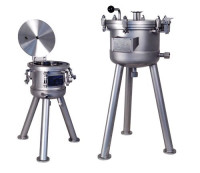
A split-ring cover clamp provides access to reactors and pressure vessels without a heavy screw cap, bulky cover clamps or a wide flange carrying moveable bolts.
A ring made from Type 4140 Steel or Type 316 Stainless Steel holds the head against the cylinder. The ring is divided into two sections that slide into place from the sides. This permits opening and closing without obstructing fittings already attached to the head.
This description defines the product family. Guaranteed performance, included hardware, exclusions, interfaces and acceptance criteria are stated only in the project-specific technical proposal and approved datasheet.
O-ring closures and compression bolt closures
When a self-sealing O-ring forms the main head seal, the split-ring sections do not need compression bolts. To close the vessel, the operator slides both sections into position and secures them with an encircling drop band or the attached quick-opening latches. This closure is suitable for most small and medium reactors and pressure vessels, as long as the intended temperature stays within the working limit of the selected O-ring. Self-sealing O-rings are not recommended for operation at low pressure.
Flat gaskets made from PTFE, flexible graphite, metal or other contained gasket materials require a different split-ring arrangement. Compression bolts fitted in the rings apply the force needed to compress and seal the gasket. A drop band or quick-opening latches hold the split-ring sections together while the bolts provide the sealing load.
Both closure styles allow the closure components to be removed completely from the vessel. The head and all its fittings can then be lifted off the cylinder, or the cylinder can be lowered away while the fittings remain connected. Compression bolts only need to be loosened or tightened; they remain in the split-ring or drop band throughout opening and closing. Keeping the bolts captive reduces handling time and avoids the need to locate removed parts.
Split-rings with hinges
On larger fixed head vessels, hinged split-rings provide a convenient way to open the closure. The ring sections swing clear of the vessel to give access for handling. This arrangement is standard on fixed head vessels of 3.75 Liters or larger. Hinged rings can also be adapted to other vessel sizes.
Split-ring closures provide the following access and handling features:
- Opening and closing leave the connections and fittings on the head undisturbed.
- Removing the head exposes the complete inside diameter of the vessel.
- The head retains the maximum available area for mounting valves and other fittings.
- Large bolted flanges and threaded studs do not obstruct vessel operation.
- The cylinder has no delicate closure threads that could gall or suffer damage during handling.
Closures with screw caps
Small vessels can use a screw cap when tightening the main cap alone develops enough force to seal the vessel. A screw cap permits a more compact closure than a split-ring assembly. This arrangement is used mainly on general purpose vessels with capacities below 100 mL.





| Brand | Coretest |
