Send a request
Solids/Slurry Addition Devices for Stirred Reactors
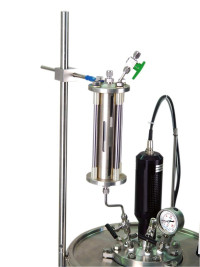
Solids and slurry addition devices allow liquids, solids or slurries to enter a stirred vessel while its head remains installed. A charging port or another feed arrangement can be incorporated as a frequently requested reactor modification, using several possible configurations.
This description defines the product family. Guaranteed performance, included hardware, exclusions, interfaces and acceptance criteria are stated only in the project-specific technical proposal and approved datasheet.
Ball valve port for solids charging
A ball valve with a 3/8″ opening can be fitted to vessels of one liter or larger. Used with a high pressure pipette, it permits slurry injection while the vessel is under pressure. A quarter turn of the handle opens or closes the passage. Vessels of 1 gallon and above can accept larger diameter valves. At moderate temperatures these valves can withstand the reactor's full developed pressure. Above 100 °C, however, their pressure rating decreases rapidly.
Ports for charging solids Valve type Nominal connection size Flow opening diameter, in. Ball valve 1/4″ NPT (F) 0.250 Ball valve 3/8″ NPT (F) 0.375 Ball valve 1/2″ NPT (F) 0.406 Internal Catalyst Addition Device (ICAD)
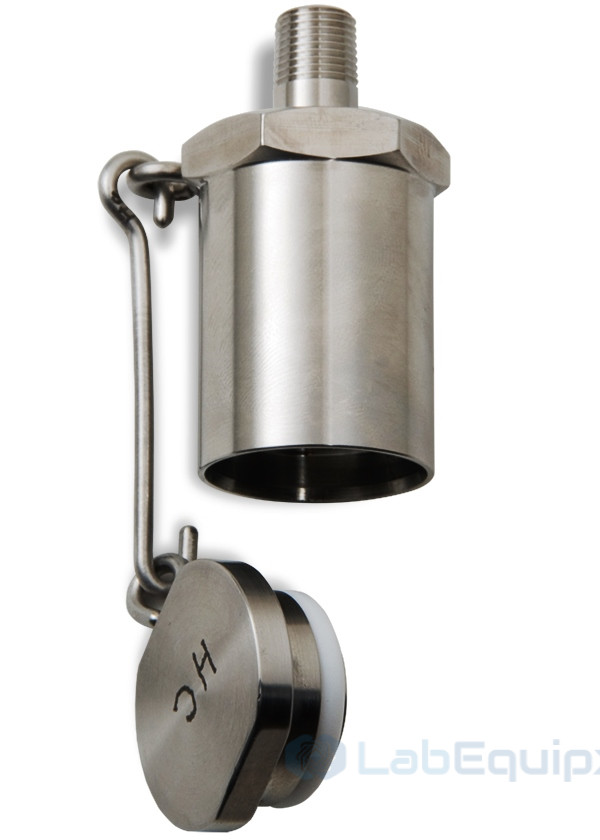
The internal addition device releases a small charge of solid or liquid from a sealed container mounted inside the reactor. It is particularly useful in kinetic studies of catalytic reactions. A small cylindrical chamber holds the charge, and an O-ring seals its cap to the chamber body. The standard PTFE O-ring limits use to ∼260 °C. An optional high temperature O-ring is available on request. The device mounts below the vessel head through a 1/8″ NPT connection. Gas supplied through a valve on top of the head pressurizes the chamber. Once this applied pressure exceeds reactor pressure, it forces the cap open and releases the catalyst or other contents into the reactor. The arrangement works best in the taller 450 mL and 600 mL mini reactors and in reactors of 1 liter or larger.
Internal catalyst addition assemblies Reactor configuration Chamber capacity, cc Assembly type Connection thread Mini 6 Internal addition device 1/8″ NPT One Liter 8 Internal addition device 1/8″ NPT Larger 20 Internal addition device 1/8″ NPT Atmospheric solids charging device
A charging device fitted in the reactor head provides a port for introducing solids at atmospheric pressure. An internal taper machined in the body helps guide the charge into the vessel. A screw cap closes the opening, with an FKM O-ring providing the seal for operation up to 225 °C. Other O-ring materials are available on request where higher temperatures or different chemical compatibility requirements apply.
Connections for solids charging and the External Catalyst Addition Device (XCAD) Reactor size Fitting sizes available Mini 1/4″ NPT (M) 1 & 2 Liter 3/8″ NPT (M) Gallon & up 1/2″, 3/4″, & 1″ NPT (M) External Catalyst Addition Device (XCAD)
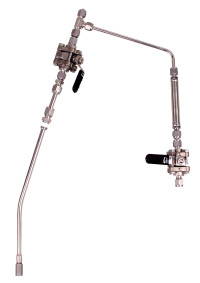
Adding a dedicated 5 mL or 10 mL chamber to the solids charging device provides two further operating capabilities. This chamber has a closure that needs no tools and an assembly containing two valves:
- The chamber and valve assembly can be detached from the reactor without tools. It can then be filled in a glove box, for example when charging a catalyst that is sensitive to the atmosphere.
- After the assembly has been reconnected to the reactor, a high pressure gas supply can be attached at its top. Gas pressure then introduces the catalyst into the reactor at elevated temperature and pressure.
Like the internal ICAD, the external device supports kinetic studies. It is often used with a gas burette to screen and characterize hydrogenation catalysts under constant pressure conditions.






| Brand | Coretest |
