Send a request
Bottom Drain Valves for Stirred Reactors
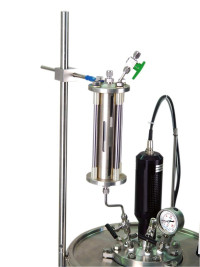
LEBDVSR Bottom Drain Valves permit product removal from most stirred reactors. They are especially useful for polymers and other materials that must leave the vessel while hot, before solidification. They also simplify recovery from 1 gallon and larger vessels that are difficult to lift out of the heater. Micro and Mini Reactors rarely need bottom valves because their vessels are small and light.
Valve action and sizing
The standard valve has a rising stem that finishes flush with the inside bottom of the cylinder. This eliminates dead space between the vessel floor and the shutoff point. Fully opening the valve retracts the stem completely and leaves an unobstructed drain passage.
Closing the valve raises the stem and pushes material remaining in that passage back into the reactor. A clear passage of 3/8″ diameter is recommended for vessels from 1000 mL to 2 gallons. A 1/4″ valve is available for capacities of 600 mL and smaller. High pressure versions and larger passage diameters can also be supplied.
Ratings and installation
When closed, the valves support the full operating pressure and temperature of their vessels. They are available in all current materials of construction. A reactor ordered with a drain valve can also have a tapered bottom to promote flow toward the outlet.
Not every reactor accepts a bottom drain. The valve projects approximately 8 inches below the vessel, so the vessel mounting must be raised by the same amount. Some arrangements then become too tall for convenient bench top use.
The specification tables identify reactors that accept a drain directly, reactors that cannot accept one, and versions requiring changes to the heater and support stand before a bottom valve can be installed.
This description defines the product family. Guaranteed performance, included hardware, exclusions, interfaces and acceptance criteria are stated only in the project-specific technical proposal and approved datasheet.
Bottom outlet valve type Flow opening diameter, in Outlet fitting Pressure limit, psi Temperature limit, ºC Sealing material PTFE-sealed valve 0.20 1/4″ NPT (F) 3000 225 PTFE Silver-sealed valve 0.20 1/4″ NPT (F) 3000 350 Silver Graphite-sealed valve 0.34 3/8″ NPT (F) 2000 350 Flexible graphite Heater-ready graphite-sealed valve* 0.34 3/8″ NPT (F) 2000 350 Flexible graphite Silver-sealed valve 0.34 3/8″ NPT (F) 2000 350 Silver Silver-sealed high pressure valve 0.31 3/8″ NPT (F) 5000 500 Silver Silver-sealed large opening valve 0.69 1″ NPT (F) 1900 350 Silver *Configured to accept a band heater. Alternative needle and ball outlet valves
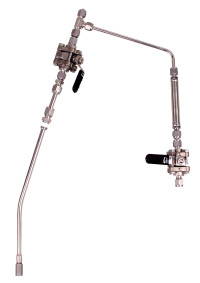
A needle valve or ball valve can also serve as the bottom outlet. Needle valves are normally selected for smaller reactors. Ball valves provide larger discharge passages, but their operating temperature and pressure limits are generally more restrictive. They also create a relatively large dead volume between the vessel bottom and the valve seat.




| Brand | Coretest |
