Send a request
Modular Reactor Controller for Stirred Reactors LERCSR-4848
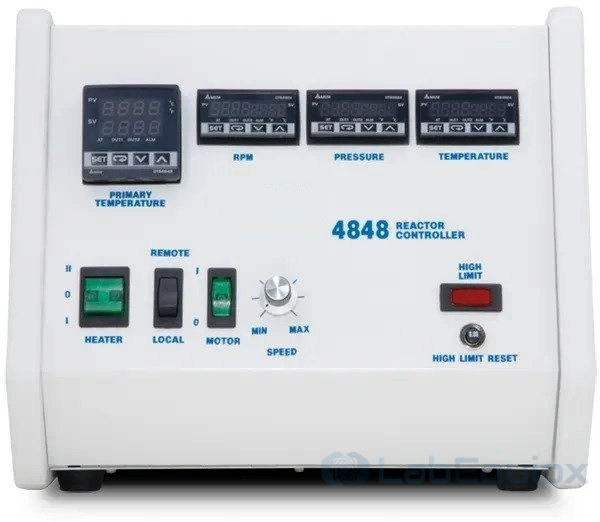
The LERCSR-4848 Reactor Controller provides modular control of stirred reactors, with digital communication across its functions. The general purpose controller offers the following features:
- PID programming and auto-tuning for accurate temperature control with limited overshoot.
- Ramp and soak programming for temperature profiles.
- Independent control loops for heating and cooling.
- An optional Solenoid Valve Module to control cooling.
- Control of stirrer motor speed.
- A high or low power selection switch for the heater.
- An overtemperature lockout relay with reset.
- Optional tachometer, pressure and high temperature alarm expansion modules.
The primary temperature control module and every expansion module have bidirectional RS-485 digital communication. A PC can record all current readings and transmit temperature set points, stirrer speeds and alarm values to the controller.
Expanded Reactor Controller
The expanded version has a larger enclosure and uses the same Primary Temperature Control Module as the standard unit. It accommodates up to six expansion modules and communicates with compatible control and monitoring software.
This version serves processes needing more modules than the standard controller can house. A typical stirred reactor installation displays both the internal reactor pressure and the pressure of an external gas burette. The expanded chassis provides space for the additional modules and their cables.
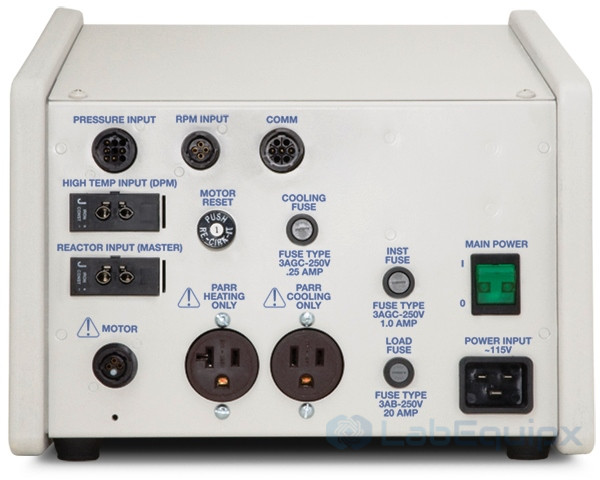
Two optional Auxiliary modules accept analog signals, most commonly 4-20mA or 0-5VDC. A dedicated auxiliary input slot routes these signals into the chassis.
Master Controller
The master configuration normally serves multi-zone heaters, including those on larger floor stand stirred reactors. It connects to one or more slave boxes so that each heating zone can use a dedicated power supply.
Reactor Controller for AC Motors
The AC motor configuration supports a tachometer display or motor control module for an AC drive. DC motors are widely used in this equipment, but certain specialized applications require an AC motor and the corresponding controller arrangement.
This description defines the product family. Guaranteed performance, included hardware, exclusions, interfaces and acceptance criteria are stated only in the project-specific technical proposal and approved datasheet.
Controller module arrangement
The controller is offered with a selection of modules. Alongside its primary temperature control, the enclosure accepts a maximum of three expansion modules. The tachometer display and motor control modules are alternatives, so only one of those options is selected. The high temperature cut off and external temperature limit modules are also alternative selections.
Primary Temperature Control Module (PTM)
The primary module accepts a thermocouple or an RTD temperature sensor. Its three outputs control heating, control cooling and disconnect the heater in response to an alarm. Temperature regulation uses proportional, integral and derivative (PID) action with an auto-tune function. Ramp and soak programs can contain up to 49 segments, allowing the controller to follow a programmed temperature sequence.
Pressure Display Module (PDM)
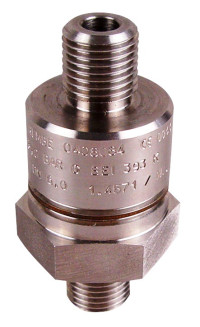
A pressure transducer on the reactor or on an attached accessory supplies the pressure monitoring input. The module can be configured for a wide choice of operating pressure ranges. It continuously sends the operating pressure to the PC. Calibration is available in psi, bar or MPa. The monitoring output connects to the alarm relay. If pressure reaches the high pressure limit entered by the operator, that relay removes power from the heater.
Tachometer Display Module (TDM)
The tachometer module shows the speed of the stirrer and continually sends the speed reading to the PC for display and recording. With this arrangement, the operator sets stirrer speed manually at the potentiometer located on the front of the controller. The module provides the speed indication while the front control determines the setting.
Motor Control Module (MCM)
This module regulates reactor stirring speed through closed loop feedback. Its primary output changes motor voltage as the load on the motor changes. Compared with standard open loop speed adjustment, this arrangement gives tighter speed regulation, particularly during reactions in which viscosity varies. The host PC can also change the stirrer speed set point remotely. To hold a constant speed, the controller changes its output according to the load on the motor. The output value therefore gives an indication of motor loading. It is not a direct measurement of torque, but it can help track reaction progress when viscosity changes during the reaction.
Motor Torque Module (MTM)
The MTM displays the motor output supplied by an MCM. This indication is particularly useful when the process involves changes in viscosity and the associated load on the stirring motor.
High Temperature Cut Off Module (HTM)
The high temperature limit controller supplements the main temperature control module. It uses a separate, redundant sensor, which may be fitted inside or outside the reactor. The module's primary output operates the lockout relay. This provides a safety shutdown if the reactor temperature reaches an unsafe level, independently of the main control function.
External Temperature Limit Module (ETLM)
This arrangement uses the HTM module with its sensor positioned to measure the outside wall of the reactor. The primary output restricts the external temperature by interrupting the main temperature controller's control signal whenever the wall temperature exceeds a predetermined value. A secondary output operates the lockout relay without latching if the external wall reaches a separate preset unsafe temperature. External wall limiting offers an alternative to cascade control. It improves temperature regulation where thermal response is slow, including non-stirred reactors and systems with PTFE liners. It also applies where the reactants have low heat capacity, as in gas phase reactions.
Solenoid Valve Module (SVM)
The coolant control package contains a solenoid valve, a flow adjustment valve and the parts needed to assemble an automatic flow control system for a reactor cooling coil. The assembled package connects to the controller's cooling output socket. Tap water is the intended cooling medium for this valve arrangement.
Included logging software
An RS-485 to USB conversion cable is required to operate the software connection.
Each controller includes software for straightforward data logging. Operation of this logging connection requires the RS-485 to USB conversion cable. The cable provides the interface needed between the controller and the computer.
Controller enclosure dimensions Controller version Width, in. Height, in. Depth, in. Standard version 11.1 9.7 11.3 Expanded version 13.6 9.6 11.3 Configurable controller software
The process controller software provides a graphical user interface that can be adjusted to the application. A shared Modbus communication architecture also supports the modular temperature and reactor controllers. Through that common communication method, the software can provide the same configurable operating interface for the supported controller families.
The available software version supports instruments containing up to eight separate loop or limit controllers. Supported controller combinations are provided on request. Compared with the standard logging software, the configurable version adds the plotting, recording and interface functions listed below. These functions provide access to controller parameters and operating events as well as to the measured process values.
- Real time plotting supports multiple charts, with an unlimited number of pens on each chart.
- Data recording can include any controller parameter rather than only the process variable.
- Alarms and events can be recorded in a log.
- Alarm annunciation provides enhanced indication of alarm conditions.
- The operating interface can be customized for the requirements of a particular application.
- Interface localization supports different languages.
Software operating system requirements
The software runs under the following Windows operating systems:
- Windows 10, 8, 8.1, & 7, in 32 bit & 64 bit versions.
Windows 8 RT, including its use on some tablet computers, is not supported by this software. Compatibility with the software version supplied is confirmed on request.
Minimum recommended computer
- A processor that meets the requirements of the Windows version in use.
- 4GB RAM, with 8GB or more recommended because Windows uses most of the minimum memory allowance.
- 1GB of hard disk capacity for installation of the software and associated utilities.
- Extra disk capacity for recorded data, depending on the quantity of data and the logging interval.
- A display adapter supporting 1024 x 768 pixels with at least 16-bit color.
- 2 USB ports for the required connections.
Preferred computer configuration
- A processor running at 2.6 GHz.
- 8GB RAM for the operating system and application.
- A 500 GB hard disk with sufficient additional capacity for data logging.





| Brand | Coretest |
