Send a request
CT-RCA-PCRI
Capillary Pressure and Resistivity System (Porous Plate)
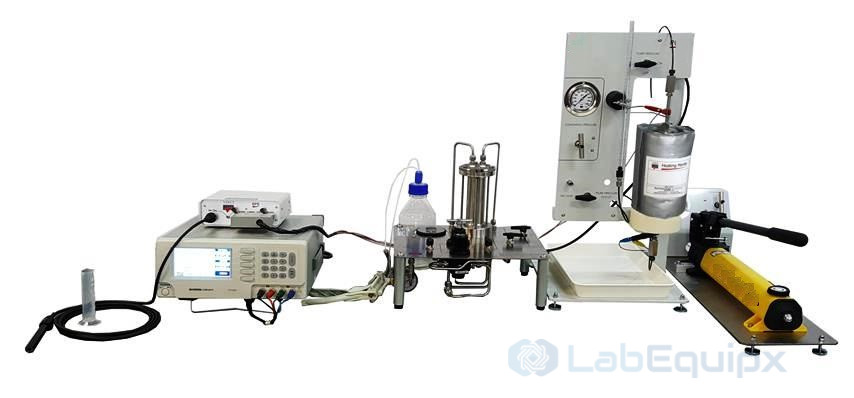
The Capillary Pressure and Resistivity System (Porous Plate), model CT-RCA-PCRI, measures the capillary pressure versus water saturation curve by the porous-plate method and the electrical resistivity of the plug at each saturation step, in the same cell. Pairing the two readings gives the resistivity index and saturation exponent used in Archie-based log analysis. The system is part of the electrical properties range alongside the ambient and overburden electrical properties systems and the calibrated resistivity check plugs.
How it works
A 1 in. or 1.5 in. diameter plug up to 3 in. long is loaded on a porous plate in a stainless steel cell under overburden pressure up to 10,000 psi and temperature up to 90 °C. Pore pressure is raised in steps up to 200 psi to displace brine through the plate in a forced-drainage cycle; gas/liquid and liquid/liquid tests are both possible with stock tank oil, laboratory oil, brine or nitrogen. A nitrogen supply at 300 psi is required. At each step the plug resistance is measured with two electrodes to 0.1% accuracy and the saturation is recorded. The controlled variables are capillary pressure and electrical excitation; the measured variables are capillary pressure, saturation and resistivity. Power is 110 to 220 VAC, 50 or 60 Hz.
What is included
- Porous-plate cell with stainless steel wetted parts for 1 in. or 1.5 in. plugs up to 3 in. long
- Overburden pressure system rated 10,000 psi
- Two-electrode resistivity measurement, 0.1% accuracy
- Temperature control to 90 °C
- Data acquisition and software: stated in the project datasheet
Specify for your project
- Plug diameter and length
- Fluid pair (gas/liquid or liquid/liquid) and the oil and brine to be used
- Overburden pressure and test temperature
- Maximum capillary pressure within the 200 psi pore pressure range
- Number of samples per run and supply voltage
This description defines the product family. Guaranteed performance, included hardware, exclusions, interfaces and acceptance criteria are stated only in the project-specific technical proposal and approved datasheet.
Features
- Pore pressure: up to 200 psi
- Overburden pressure: up to 10,000 psi
- Temperature : up to 90°C
- Core diameter : 1" or 1.5" Core length : up to 3"
- Resistivity measurement : 2 electrodes
- Resistivity accuracy: 0.1%
- Test : gas/liquid and liquid/liquid
- Capillary pressure cycle: forced drainage
- Wetted parts : stainless steel
- Power supply : 110-220 VAC, 50 or 60 Hz
- Fluid types: stock tank oïl, lab-oil, brine, nitrogen, gas
- Nitrogen requirement : 300 psi
| Model | CT-RCA-PCRI |
| Brand | Coretest |
