Send a request
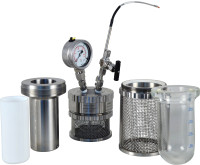
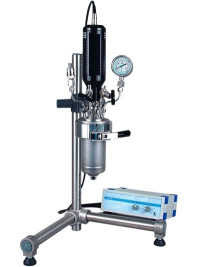
Compact Glass and Steel Pressure Reactor, 100 to 300 ml, 150 bar LEPSPR
Features:
- Small-scale chemical synthesis in interchangeable glass or steel pressure vessels
- Reactor volume: 100 to 300 ml
- Pressure: -1 to +150 bar
- Temperature: -20 °C to +300 °C
- Material: borosilicate glass 3.3, stainless steel, Hastelloy®
- Other materials, pressures and temperatures are available on request.
- One multipurpose reactor system accepts both glass and steel pressure vessels. Built-in safety features allow reactions to be run safely under pressure.
- Glass vessels resist acids well and allow the process to be observed visually. Steel vessels are used for high pressure reactions. A magnetic stirrer drive provides efficient mixing and good heat transfer.
- A quick-release closure allows vessels to be exchanged without tools.
- The modular design allows the system to be changed or upgraded for new tasks at any time.
- A wide range of accessories is available. The right setup for a specific task is defined on request.
Model: LEPSPR
Standard package
- Safety housing with polycarbonate sliding door for safe operation of glass pressure vessels
- Pressure vessel in glass, or in steel / Hastelloy®, with matching stirrer shaft, stirrer and Pt-100 sensor
- Safety quick-release closure
- Cover plate with 6 openings and standard fittings:
- Double ferrule compression fittings with bursting disc, pressure gauge and 2 valves
- Magnetic stirrer drive with integrated high torque magnetic coupling and speed controller
- Tools and spare parts
Standard options
- Electric heating / water cooling
- Measurement and control systems
- Wide range of accessories
Jacketed pressure vessels for thermostat heating

Pressure vessels with electric heating and water cooling

Examples

Typical applications
- Hydrogenation
- Polymerization
- Synthesis
- Catalyst testing and evaluation
- Catalytic reactions
- Crystallization
- Chemical research
- Petrochemical research
- Corrosion measurement
- Upstream research
- Biomass research
- Biopolymer research
- Biorefinery research
- Biofuels research
- Zeolite synthesis
- Nanoparticle synthesis
- Corrosion testing in an autoclave

Related products




| Brand | Coretest |
