Send a request
Multiple Reactor System MRS-5000 Series
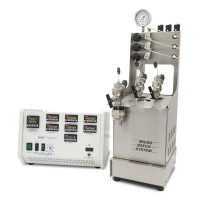
The LEMRS-5000 Multiple Reactor System runs several reactions at the same time in an integrated assembly. It supports high throughput experiments conducted under elevated pressure and temperature.
System capabilities
- Six reactors, each with internal stirring.
- Working pressures reaching 2900 psi (200 bar).
- Operating temperatures reaching 300 °C.
- Separate temperature regulation for each vessel.
- Continuous pressure monitoring for each reactor.
- Computer-based operation and recording of test data.
- A manifold arrangement for quick turnaround and admission of two different feed gases.
- Reactor volumes and geometry suited to three-phase reactions.
- Control software that accommodates different operating requirements.
This description defines the product family. Guaranteed performance, included hardware, exclusions, interfaces and acceptance criteria are stated only in the project-specific technical proposal and approved datasheet.
Stirred vessels for parallel batch reactions
The multiple reaction system uses stirred vessels with a total capacity of 75 mL. Each vessel accepts a liquid reactant charge between 15 and 40 mL. This charge range is close to the minimum practical liquid volume for heterogeneous catalytic reactions. A system fitted with 45 mL vessels is available as an alternative.
The vessel, valves and accessories support maximum operating pressures up to 2900 psi (200 bar) at operating temperatures up to 300 °C. The selected vessel seal determines the applicable temperature limit within this range.
Common magnetic stirring drive
A single magnetic stirring assembly operates all six vessels. The assembly is built for this arrangement, with magnetic drives and fields concentrated on the stirrer bar inside each vessel. Compact, high strength magnets provide enough coupling through the vessel walls and surrounding heaters to drive the bars. Stirrer bar speed is adjustable over 0-1200 rpm. During a run, every vessel operates at the same stirring speed. Holding speed common across the vessels allows differences in reaction rates to be compared against the other selected operating conditions rather than against different stirrer speed settings.
Individual vessel heating
External heaters surround the vessel walls to provide rapid, even heating. Each reactor has its own temperature control. A 250-watt heater at each position provides heating rates up to 15 °C per minute. An optional support rack holds the reactors for cooling in air.
Parallel operating modes
The system runs up to six reactions in parallel. The resulting data can be used to compare operating conditions and select suitable conditions for further work. Experimental arrangements include the following:
- Use the same temperature and pressure for all reactions while changing catalyst loading or reactant concentration to optimize these parameters.
- Load every reactor identically and hold a common temperature while changing pressure to determine its effect on reaction rate.
- Set the loading, temperature and pressure separately for individual reactors to screen several operating options for activity.
For reactors operating under parallel conditions, comparing pressure drop against time is usually the most useful way to assess reaction rates and compare the selected conditions. The internal thermocouple also detects temperature changes associated with exothermic reactions.
Reactor configuration options
The vessel and accessory options allow the multiple reaction system to be configured for the intended chemistry and operating conditions. Choices cover vessel sealing, valve position, construction materials, stirring elements, temperature measurement and gas supply or consumption measurement.
O-ring and flat gasket sealing
For an O-ring vessel, hand tightening the screw cap closes the vessel. The O-ring material determines the maximum operating temperature. FKM O-rings permit use up to 225 °C, while FFKM O-rings raise that limit to 275 °C. Chemical compatibility must also be checked when choosing the O-ring material. PTFE flat gaskets can operate up to 300 °C and provide very broad chemical compatibility. In the flat gasket version, six compression bolts supply the force needed to seal the gasket.
Head fittings and valve position
Each vessel has an internal thermocouple, inlet valve, exhaust valve, safety rupture disc and pressure transducer. Modifications can add a liquid sampling dip tube or a cooling cold finger. The valves, pressure transducer and rupture disc can either be fitted to a multi-port adapter directly on the vessel head or mounted remotely on the rear panel.
- Head-mounted fittings. This arrangement allows a pressurized vessel to be removed from the heater and stirrer assembly. It also permits the vessel to be filled at another location before installation. Each vessel receives flexible PEEK gas inlet tubing with a quick slip connector, which is easy to disconnect after gas filling.
- Panel-mounted fittings. All pressure inlet and outlet functions connect to each vessel through a single PTFE-lined stainless tube. An alternative stainless steel tube is available when required. With remote panel-mounted valves, the gas inlet tube normally remains connected to the vessel during operation.
Construction material selection
Type 316 Stainless Steel is standard for the vessel and its wetted parts, as well as for the gage block assemblies exposed to vapor. For strong mineral acids or other more corrosive reaction media, the vessels can be produced in most of the available standard construction materials.
Magnetic stirring elements
The magnetic stirrer bars are available with a PTFE coating or a glass coating. Either type provides stirring through the common magnetic drive assembly.
Thermocouple installation
Internal thermocouples provide direct monitoring for vessel temperature control. Each thermocouple has a stainless steel sheath and is inserted into a protective thermowell. The well allows the thermocouple to be fitted and removed conveniently, while adding chemical and mechanical protection. An external thermocouple option places a sensor in contact with the wall of each cylinder.
Gas inlet manifold
The brass manifold can accept a purge gas, normally nitrogen, and a reactant gas, normally hydrogen. It can be configured to fill all vessels automatically to the same initial pressure, or to fill each vessel manually to a separate selected operating pressure. A T316SS manifold is also available for more corrosive gas service.
Gas consumption burettes
Optional high pressure gas burettes are available when gas consumption needs to be measured. They provide the measurements used to monitor or calculate the moles of gas consumed as a reaction proceeds.
Dedicated process control
A dedicated process controller operates the multiple reaction system. The process controller documentation provides further details of the controller itself. In this application it provides the following functions:
- Separate temperature monitoring and PID control for every reactor.
- Separate pressure monitoring for every reactor.
- Logging of the temperature and pressure readings from each vessel.
- Control and recording of the common stirring speed used by the reactors.
Ramp & Soak programs can be set for individual reaction vessels. Digital inputs and outputs support interlocks, alarms and other safety functions. Further analog and digital inputs and outputs allow flow meters or other accessories to be added later. The operator station is a Windows PC; supported Windows versions are confirmed on request. A simplified graphical interface provides monitoring and operation of the multiple reaction system. The PC serves as the user interface and data logger; the dedicated process controller generates all control actions.
System specifications
Equipment configuration Multiple reaction system Vessel capacities, mL 45 75 Reaction vessel count 6 Pressure limit 2900 psi (200 bar) Temperature limits FKM O-ring seal 225 °C FFKM O-ring seal 275 °C PTFE Flat Gasket seal 300 °C Vessel closure arrangement O-ring version Screw Cap Flat gasket version Screw Cap (6 Compression Bolts) Construction material T316SS Control equipment Dedicated process controller Analog input channels 6 Temperature 6 Pressure 1 Motor Speed Analog output channels 1 Stirrer Speed (Optional) Digital output channels 6 PID Temperature Control Temperature sensing arrangement 6 Thermowells Heater arrangement 6 Band Heaters, Aluminum Block Heater power, Watts 250W Per Station, 1500 W Total Thermocouple on vessel exterior Optional Stirrer motor operation Manual or Computer Controlled Stirring element Magnetic stirrer bar coated in PTFE or Glass Electrical supply requirements Supply voltage, Volts, AC 115 or 230 Maximum current load, amps 15 / 7.5 Vessel size and weight Internal diameter, inches 1.18 1.50 Internal depth, inches 2.69 Flat Gasket, 2.50 O-ring Vessel weight, pounds 3 (with Panel-mounted valves) 6 (with Head-mounted Valves) Equipment dimensions Width, in. Depth, in. Height, in. Weight, lb. Heater assembly 25.75 9.25 2.875 31 Stirring assembly 28 9.5 7.625 12 Process controller 13 11 15 14 Remote manifold 26.5 9.0 15 36 Head-mounted manifold 26.5 9.0 15 18 Replacement parts package Spare parts kit


Related products
| Brand | Coretest |
