Send a request
Vibration basic Knowledge
Vibration testing exposes a product to controlled motion to prove it survives transport. Vibration is treated as a sine function of time, y(t) = A sin ωt, with level as displacement, velocity or acceleration. Period is 1/f, peak-to-peak amplitude is twice the single amplitude, rms is single amplitude divided by √2, and the average is single amplitude times 2/π.
How it works
A sine sweep moves the frequency continuously over a range to find resonances, set by frequency range, acceleration, sweep rate and test time. A fixed-frequency test dwells at one frequency for endurance, per IEC, GB/T 2423, MIL-STD or GJB 150. Random vibration excites all frequencies at once with a continuous spectrum, closer to real transport, and is set by power spectral density in g²/Hz, overall rms in Grms (root of the PSD area) and test time. Shock and collision tests apply single or repeated pulses to judge product and packaging; pre- and post-pulses return velocity and displacement to zero.
Acceleration, velocity and displacement are tied by frequency, a = 2πf v and v = 2πf d; a nomograph, SI units table and the G to m/s² factor 9.8 are given.
Specify for your project
- Test type: sine sweep, fixed-frequency, random or shock
- Frequency range, acceleration, sweep rate (sine)
- PSD and overall Grms (random)
- Shock pulse and repetitions
- Test time and governing standard
This description defines the product family. Guaranteed performance, included hardware, exclusions, interfaces and acceptance criteria are stated only in the project-specific technical proposal and approved datasheet.
Sine sweep test
Some law continuously changing frequency of the excitation test product, aimed at the assessment of the frequency range to find cause-specific resonance frequency.
Main parameter
- Frequency[Hz]
- Test Time[t]
- Acceleration[m/s²]
- Sweep Rate(oct/min), [Hz/min]
Fixed frequency test
Specifies an arbitrary frequency tested. Goal is endurance and strength of the resonance point detection and assessment of a particular specification under(such as IEC, GB/T2423, MIL-STD, GJB150 and other tests on the sample frequency sweep, resonance dwell test).

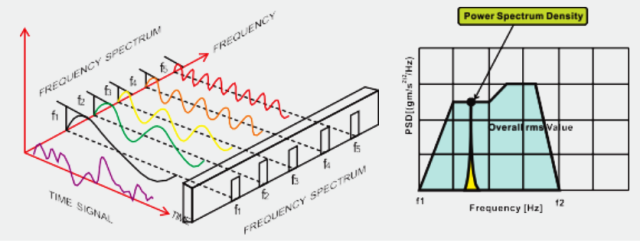
Electronic and electrical products are subjected to vibration during transportation is the most random vibration properties, random vibration frequency sinusoidal vibration than wide, and it is a continuous spectrum, it can also carry out vibration excitation on the products in all frequencies, the real clone reality.
Main parameters
- Overall RMS Value (rms) [Grms]
- Power Spectral Density(PSD)[g²/Hz]
- Test Time[T]
The impact and collision impact all belong to the category of shock pulse impact test is used to determine the main components, equipment and other products in the use and transportation process subjected to repeated(collision is repeated) and evaluate the applicability of packaging to protect the mechanical shock.
The term
- The average energy of Power Spectral Density has the units of bandwidth, which describes the process in the vibration energy distribution in different frequency bands;
- Overall rms Value curve in its predetermined test frequency range (power spectrum) under the square root of the area, but do it with the peak sinusoidal vibration were compared, there id on relationship between them;
- Pre-Pulse, post-pulse, respectively, before and after the increase in the compensation pulse before and after the main pulse is the role of the velocity and displacement finally return to the zero position.

Universal International Units
Measure name Unit name Unit abbreviation Length Meter M Mass Kilogram Kg Time Second S Velocity Meter per second m/s Acceleration Meter per second square m/s² Force Newton N Moment, Torque Newton-meter N. m Vibration nomograph

Relation among acceleration, velocity and displacement
Relation
Equation for Estimation
Acceleration a[m/s]=(2πf)□d/1000=2πfv
A[m/s] 0.0394df□※1 6.28fv ※1
Velocity v[m/s]=2πfd/1000=a/2πf
V[m/s] 0.00628fd 0.159a/f
Didplacement d[mm]=1000a/(2πf)□=1000v/2πf
D[mm] 25.5a/f²□※2 159.2v/f
- ※1 Divide the acceleration value by 9.8when its unit is G
- ※1 2 Multiply the acceleration value By 9.8 when is unit is G



| Brand | Coretest |
