Send a request
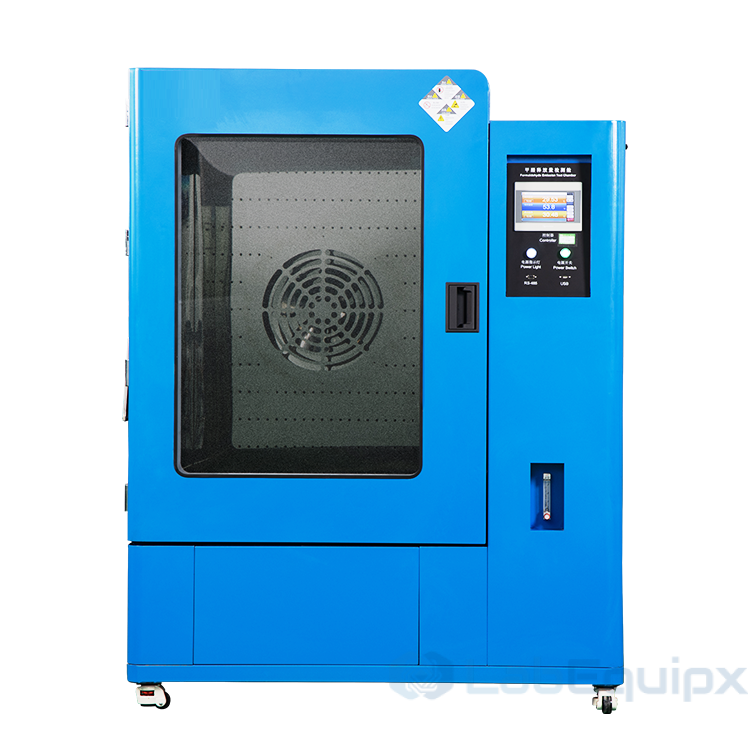
Electric Appliance VOC Emission Test Chamber
The LEEVOC is a climate-controlled emission chamber that measures the VOC emission rate and emission behaviour of electric appliances, decoration materials, plastics and electronic toys. Test results are used to study how environment variables change emissions, classify products by emission level, build indoor air pollution models and evaluate indoor air quality.
How it works
Supply air is compressed and cleaned of solid particles, formaldehyde and VOCs before it enters the chamber. An air jacket around the test chamber controls its temperature; humidity is controlled by the dew point method. The inner walls are coated stainless steel. The coating reduces adsorption of high-boiling-point and polar compounds on the wall, so recovery of tetradecane and 4-phenyl-1-cyclohexene is more than 80%.
Key data
- Temperature adjustment: 20 °C to 70 °C, fluctuation ±0.3 °C, deviation ±0.5 °C
- Humidity fluctuation ±2.5% RH, deviation 3%
- Chamber pressure: 10 ±5 Pa
- Air exchange rate: 0.2 to 5 times/h, ±5%; air velocity 0.1 to 0.3 m/s
- Background: formaldehyde less than 15 µg/m³, single VOC less than 2 µg/m³, TVOC less than 20 µg/m³
- Power: AC 380 V, 50 Hz, three-phase five-wire
Model Start-up power Running power LEEVOC-1000 15 kW 7 kW LEEVOC-2000 20 kW 9 kW LEEVOC-3000 30 kW 14 kW LEEVOC-5000 35 kW 16 kW Site conditions: ambient 5 °C to 35 °C, humidity 90% RH or less, no pollution source, TVOC 500 µg/m³ or less. Reference standards listed for these chambers include ASTM D6007-02, EN13419-1 and ENV717-1.
Specify for your project
- Chamber size from the largest appliance to be tested
- Test temperature and humidity
- Air exchange rate and sampling method
- Test standard to be followed
This description defines the product family. Guaranteed performance, included hardware, exclusions, interfaces and acceptance criteria are stated only in the project-specific technical proposal and approved datasheet.
Advantages of Electric Appliance VOC Emission Test Chamber LEEVOC
The coated stainless steel wall improves the adsorption capacity of test chamber for high-boiling-point materials and polar compounds.The recovery rate of tetradecane and 4-phenyl-1-cyclohexene can achieve more than 80%.
The surface treatment addresses the interface between the VOC emission chamber and the test object.The technology helps to reduce the surface adhesive force,largely reducing VOC’s adhesiveness on chamber’s interior wall.In this way,the testing result of samples stored in the sampling bag is more close to the result of testing object in chamber,and the testing precision chamber is largely improved.
Technical Parameters of Electric Appliance VOC Emission Test Chamber LEEVOC
Mold LEEVOC-1000 LEEVOC-2000 LEEVOC-3000 LEEVOC-5000 Environment temperature 5℃~35℃ Environment humidity ≤90%RH Environment requirements With no pollution source,TVOC≤500ug/m³ Size of climate chamber(mm) D910×W1000×H1100 D910×W2000×H1100 D1350×W1500×H1500 D1500×W1670×H2000 Temperature adjustment range 20℃~70℃ 20℃~70℃ Humidity adjustment range 30-80%RH(20~30℃) Pressure 10±5pa Temperature fluctuation ±0.3℃ Temperature deviation ±0.5℃ Humidity fluctuation ±2.5%RH Humidity deviation 3% Air exchange rate 0.2~5Times/h,±5% Air velocity 0.1m/s~0.3m/s Power supply AC 380V/50Hz/Three-phase five-wire Start-up power 15kw 20kw 30kw 35kw Runnning power 7kw 9kw 14kw 16kw Background concentration of formaldehyde Less than 15ug/m³,minimum value:6ug/m³ Background concentration of VOC Single VOC:less than 2ug/m³,TVOC:less than 20ug/m³ Recovery rate More than 80% Air purification system Standard configurations Testing Methods
- The air is first processed by compressor to remove solid particles,formaldehyde and volatile organic compounds,and then enters into the test chamber.
- The climate chamber is designed with an air jacket for conditioning the temperature in testing chamber.
- By adopting dew point method,the humidity of climate chamber is well regulated and controlled.
Manufacture Standards
GB18580-2001 Indoor Decorating and Refurbishing Materials-Limit of Formaldehyde Emission of Wood-Based Panels and Finishing Products GB18584-2001 Indoor Decorating and Refurbishing Materials-Limit of Harmful Substances of Wood Based Furniture GB18587-2001 Indoor Decorating and Refurbishing Materials-Limitations of Harmful Substances Emitted From Carpets, Carpet Cushions and Adhesives ASTM D6007-02 Standard Test Method for Determining Formaldehyde Concentration in Air from Wood Products Using A Small Scale Chamber ENV717-1 Wood-Based Panels.Determination of Formaldehyde Release.Formaldehyde Emission by the Chamber Method EN13419-1 Building Products.Determination of the Emission of Volatile Organic Compounds.Emission Test Chamber Method HJ571-2010 Technical Requirement for Environmental Labeling Products Wood Based Panels and Finishing Products HJ566-2010 Technical Requirement for Environmental Labeling Products Wooden Toys Standards for Reference
ASTMD5116-97 Standard Guide for Small-Scale Environmental Chamber Determinations of Organic Emission from Indoor Materials/Products ASTMD6330-98 Standard Practice for Determination of Volatile Organic Compounds (Excluding Formaldehyde) Emissions from Wood-Based Panels Using Small Environmental Chambers Under Defined Test Conditions ASTMD6670-01 Standard Practice for Full-Scale Chamber Determination of Volatile Organic Emissions from Indoor Materials/Products ASTMD1333-96 Standard Test Method for Determining Formaldehyde Concentrations in Air and Emission Rates from Wood Products Using a Large Chamber

| Brand | Coretest |
