Send a request
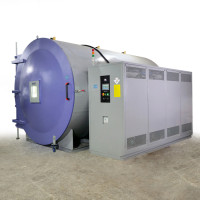
Thermal Vacuum Test System
The Thermal Vacuum Test System LEVS exposes satellite components and payloads to the vacuum and temperature extremes of orbit. A cylindrical chamber is pumped to an ultimate vacuum better than 1×10⁻⁵ Pa (working vacuum better than 1.3×10⁻⁴ Pa) while a fluid-cooled heat sink holds the specimen between -180 °C and +200 °C with ±0.5 °C accuracy. Chambers are built horizontal or vertical in six sizes, LEVS-500 to LEVS-3000.
How it works
The shell is welded AISI 304L stainless steel, sandblasted outside, with vacuum and refrigeration systems in the same frame. A two-stage vane pump takes the chamber to 10⁻² torr, then a helium cryogenic pump behind a gate valve reaches working vacuum, with exhaust filters and a gauge system for each stage. The door has its own heat sink section and a fluororubber O-ring.
The heat sink is two AISI 304L sheets riveted and welded with an internal passage, so control fluid covers the whole surface; it reaches 100 K or below with uniformity within ±5 °C. Its inner wall is painted black, solar absorptance at least 0.95 and hemispheric emittance at least 0.90, with an outer radiation shield. Infrared heating arrays or cages deliver 100 to 1800 W/m², and a solar, ultraviolet or lighting simulator can be added.
Model Working diameter Working length LEVS-500 500 mm 1000 mm LEVS-1200 1200 mm 1500 mm LEVS-1500 1500 mm 2000 mm LEVS-2000 2000 mm 3000 mm LEVS-2500 2500 to 17000 mm 5000 to 32000 mm LEVS-3000 3000 to 17000 mm 6000 to 32000 mm What is included
- Vacuum chamber, horizontal or vertical
- Pump set: two-stage vane pump, helium cryogenic pump, gate valve, exhaust filters and pressure gauge system
- Fluid-circulated heat sink with black inner coating and outer radiation shield
- Infrared heating array or cage
- Vacuum and temperature measurement
Specify for your project
- Specimen envelope: working diameter and length, horizontal or vertical layout
- Temperature range and cooling method: liquid refrigerant, refrigeration machine, nitrogen gas or oil bath
- Required working vacuum
- Irradiance and source: infrared array or cage, solar simulator, ultraviolet simulator
- Site power: three-phase 220 V, 380 V or 480 V, 50/60 Hz
This description defines the product family. Guaranteed performance, included hardware, exclusions, interfaces and acceptance criteria are stated only in the project-specific technical proposal and approved datasheet.
Main Technology Parameters
(1) Ultimate vacuum: better than 1×10﹣5Pa
(2) Working vacuum:better than 1.3×10﹣4Pa
(3) Temperature range: ﹣180℃~200℃
(4) Temperature Accuracy:±0.5℃
(5) Temperature of the heat sink: ≤100K
(6) Uniformity of heat sink temperature: ≤±5℃
(7) Black paint for inner wall of heat sink, Absorption of sunlight by heat sink≥0.95 Hemispheric emittance≥0.90, The outer surface is equipped with radiation shield.
(8) Infrared heating heat flux density 100W/m2~1800W/m2
(9) With vacuum degree and temperature measurement function
The vastness of space is both familiar and strange to human. Familiar, because manned space activities have been carried out for decades, man has been into space hundreds of times. Strange, because the space environment is so complex, that every manned space activities, is still full of numerous changes and great risks. Facing the complicated and changeable environment of manned spaceflight, the astronauts can successfully complete the mission of manned spaceflight only when they make full preparation of test and training on the earth. Ground test and training cannot be separated from simulation technology simulation equipment.As to understand the simulation technology and simulation equipment, first of all should understand the manned space environment.
The vastness of space is both familiar and strange to human. Familiar, because manned space activities have been carried out for decades, man has been into space hundreds of times. Strange, because the space environment is so complex, that every manned space activities, is still full of numerous changes and great risks. Facing the complicated and changeable environment of manned spaceflight, the astronauts can successfully complete the mission of manned spaceflight only when they make full preparation of test and training on the earth. Ground test and training cannot be separated from simulation technology simulation equipment.As to understand the simulation technology and simulation equipment, first of all should understand the manned space environment.
Container way Horizontal Vertical Model No LEVS-500 LEVS-1200 LEVS-1500 LEVS-2000 LEVS-2500 LEVS-3000 Working Diameter(mm) 500 1200 1500 2000 2500~17000 3000~17000 Working Length(mm) 1000 1500 2000 3000 5000~32000 6000~32000 No-load ultimate vacuum /Pa 1×10﹣5Pa 1×10﹣5Pa temperature range /℃ -180℃~200℃ refrigerating method liquid refrigerant,refrigerating machine,Nitrogen gas temperature,Bath oil temperature Infrared heating mode Infrared heating array,Infrared heating cage irradiance 100W/m2~1800W/m2 Irradiation way solar simulator,Ultraviolet irradiation simulator,Lighting environment simulation system power conditions AC 3Ψ 220V;3Ψ380V; 3Ψ480V+N+G, 60/50Hz Customized Service Welcome to custom size, Non-standard,Specail requirements,OEM/ODM orders. The technical information will be subjected to change without notice Important features of the structure
(1) Box structure: one-piece structure, vacuum system,The refrigeration system is placed in the same frame. Cylindrical shell can well meet the requirements of vacuum pressure,It is made of stainless steel AISI304L with a seamless welding process. The outer surface is sandblasted with high quality. Meet aesthetic and long-term use needs.
(2) Door: External sandblasting internal heat sink to meet the needs of uniformity, Equipped with wheel lock and fluororubber o-washer.
(3) Door open way: Mechanical hinges ensure sealing, Specially designed for easy opening.
(4) Heat sink structure: Special riveting and welding techniques weld two stainless steel sheets(AISI 304 L) together, There is room inside for temperature regulation of fluid circulation. This technique produces good temperature uniformity, Because the thermoregulation fluid covers the entire surface of heat sink.
(5) Vacuum system: International first-class brand, Includes a bipolar vane pump with a vacuum of 10-2torr, A helium cryogenic pump with exhaust filters for the pump set. Can very good recovery of oil pollution, prevent pollution of the environment. The suction of the pump set is connected to the helium cryogenic pump, Connect to the test box through the gate valve. A pressure gauge system displays each pressure by analog or digital display, To check the correct operation of each valve(Open and close).

Related products
| Brand | Coretest |
